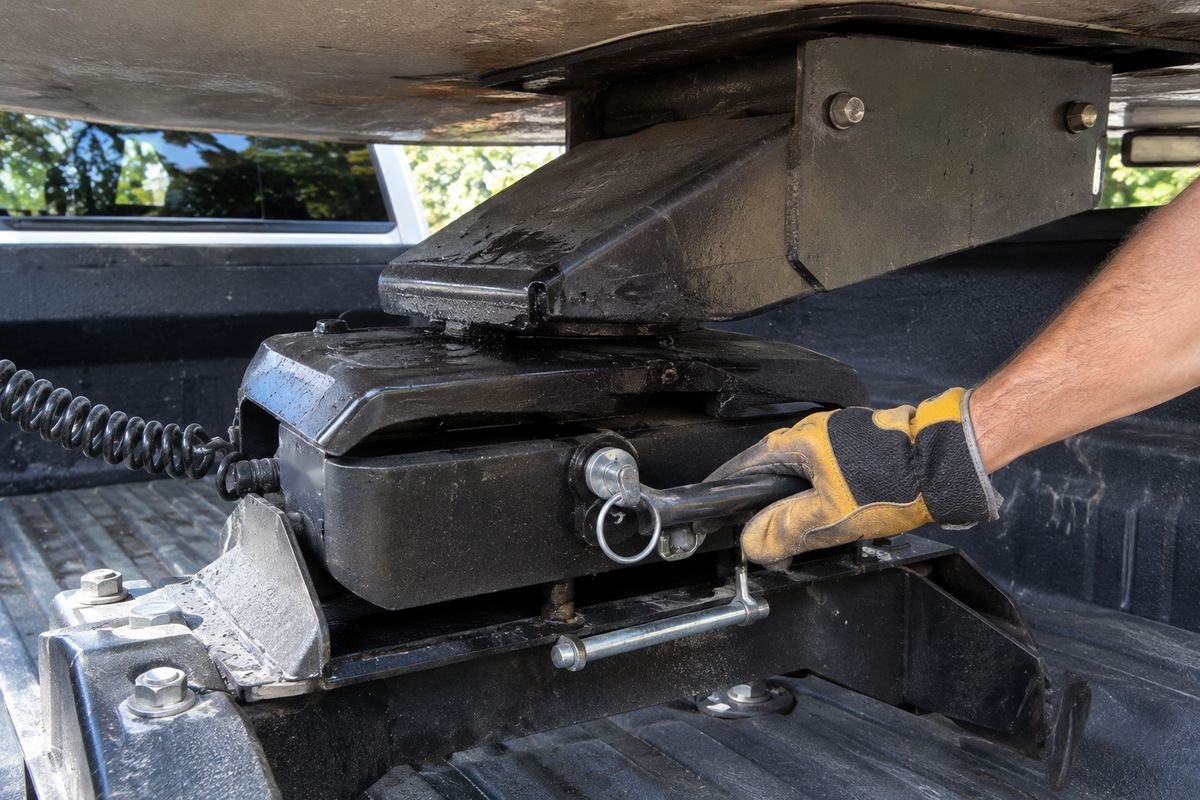
Quick answer: The best fifth wheel hitch is the one that fits how your truck is set up. If you have a 2020 or newer GM heavy duty truck with factory pucks, the B&W Companion OEM 20K fits into the pucks with no rails. Short bed owners need more turning room, so look at a slider such as the B&W Companion OEM Slider or the automatic PullRite SuperGlide. Whatever you buy, its rating must be at or above your trailer's GVWR, and the pin weight must fit inside your truck's payload.
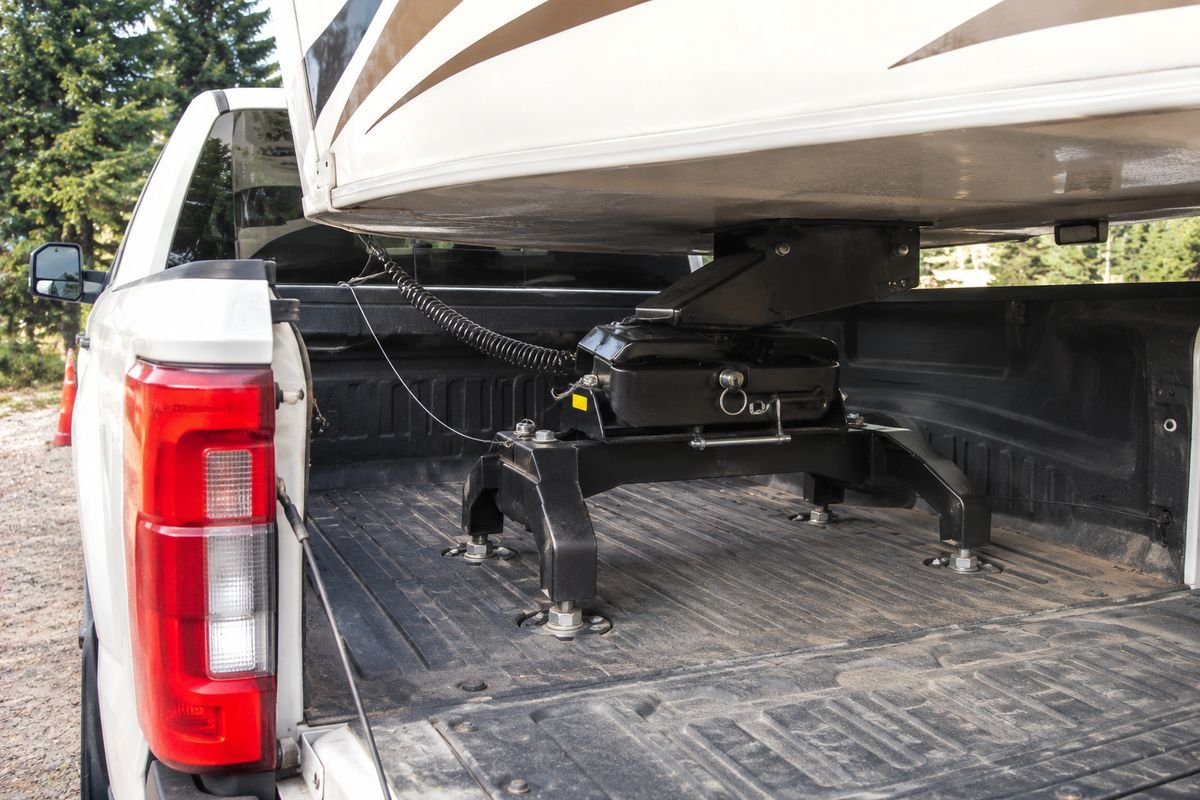
Table of Contents
A fifth wheel hitch is the coupler in the bed of a pickup that locks onto the kingpin under the nose of a fifth wheel trailer. Picking one comes down to three things: how it mounts in your truck, how much weight it is rated for, and whether your bed is long enough to turn without hitting the cab. This guide covers all three, plus six fifth wheel hitches worth a look. We have not tested these hitches ourselves. The details come from the manufacturers, their Amazon listings, and truck-maker towing guides.
How to choose a fifth wheel hitch
- Match the mount to your truck. Many newer Ford, GM, and Ram heavy-duty trucks have factory puck systems. A puck hitch made for your truck fits in with no drilling. Older trucks use rails bolted through the bed.
- Match the rating to the trailer. The hitch's trailer weight rating should be at or above the trailer's GVWR, which is the most the loaded trailer can weigh. Don't use the trailer's empty weight.
- Check the pin weight. Ram's towing guide says fifth wheel pin weight should be more than 15 percent and less than 25 percent of the trailer weight. That weight counts against your truck's payload.
- Measure your bed. CURT says short bed trucks need extra cab clearance when turning and suggests a sliding hitch. Long beds usually have room, but CURT notes some long bed setups still need a slider.
- Check the height. The trailer should sit level with several inches of room between the truck bed rails and the trailer. Most hitches adjust in steps.
The hitch does not raise your truck's limits
B&W's owner's manual puts it plainly: even if the hitch is rated to tow your load, never go over your truck's GVWR, GCWR or maximum tow rating. Ram adds that the weight of the hitch itself counts against what the truck can carry.
Fifth wheel hitch mount types
There are three common ways a fifth wheel hitch mounts in a pickup bed.
Swipe to see more →
| Mount type | How it works | Best for |
|---|---|---|
| Factory puck system | Legs drop into pucks built into the truck frame. No drilling. | Newer Ford, GM and Ram heavy duty trucks with the factory prep package |
| Universal rails | Two steel rails bolt through the bed to brackets on the frame. The hitch sits on the rails. | Trucks without factory pucks, or owners who switch hitches |
| Gooseneck ball mount | The hitch or coupler locks onto a gooseneck ball in the bed. | Owners who also tow gooseneck trailers or want a light setup |
Fifth wheel hitch finder
Select your truck setup and enter your trailer's GVWR to get a starting point and an estimated pin weight.
Fifth Wheel Hitch Finder
Answer four questions to see which hitch type fits your truck and trailer. This is a starting point, not a fitment check.
Hitch finder by RestfulRV. Based on maker ratings from B&W, CURT, PullRite and Andersen. Always check your truck's payload and towing ratings and the hitch maker's fit guide.
Quick comparison
Swipe to see more →
| Pick | Rating | Mount | Slides |
|---|---|---|---|
| B&W Companion OEM 20K (RVK3710) | 20,000 lb trailer, 5,000 lb pin | 2020 to 2026 GM factory pucks | No |
| B&W Companion OEM Slider (RVK3775) | 20,000 lb trailer, 5,000 lb pin | 2020 to 2026 GM factory pucks | 12 inches, manual |
| PullRite SuperGlide 2900 | 20,000 lb trailer, 5,000 lb pin | Industry standard rails | 14 inches, automatic |
| CURT A16 with Ford Puck Legs (16033) | 16,000 lb trailer, 4,000 lb pin | Ford factory pucks, 8 ft bed | No |
| CURT A16 for GM 8 ft Puck Trucks (16091) | 16,000 lb trailer, 4,000 lb pin | GM factory pucks, 8 ft bed | No |
| Andersen Ultimate 5th Wheel Connection (3220) | 24,000 lb trailer, 4,500 lb pin | Gooseneck ball in the bed | No |
Fit depends on your exact truck, year and bed length. Read the notes for each pick below and check the maker's fit guide before you buy.
6 fifth wheel hitches worth a look
All six were in stock on Amazon on 5 Nov 2026 and sold by the maker or by Amazon.
If you own a 2020 to 2026 Chevrolet or GMC heavy duty truck with the factory puck system, the Companion OEM drops straight into the pucks. You turn the handle, pin it, and you are ready to hitch. There are no rails to bolt into the bed, and the bed is clear again when you lift the hitch out.
B&W rates it for 20,000 pounds of trailer weight and 5,000 pounds of pin weight. The head fully articulates and has a side-to-side shock absorber, and B&W says no lube disc is required.
Good
- Drops into the factory pucks with no rails
- High 20,000 lb rating
- No lube disc required, per B&W
Bad
- Fits 2020 to 2026 GM puck trucks only
- Not a slider, so check cab clearance on short beds
This is the Companion OEM with a 12 inch manual slide for 2020 to 2026 GM puck trucks. On a short bed, the trailer nose can hit the cab in a tight turn. Moving the head back to the maneuver position adds turning room.
It has two positions, tow and maneuver, set with a locking handle. B&W says to stay at 5 mph or less in the maneuver position. It carries the same 20,000 pound trailer and 5,000 pound pin ratings as the standard Companion OEM.
Good
- Adds turning room for short beds
- Same ratings as the standard Companion
- No rails needed on GM puck trucks
Bad
- Manual slide, so you get out to move it before tight turns
- Heavy, about 256 pounds per the listing
The SuperGlide slides on its own. As you turn, the hitch moves the trailer up to 14 inches back from the cab, then returns when you straighten out. You never have to get out and throw a lever, which is the main complaint with manual sliders.
PullRite rates the 2900 for 20,000 pounds of trailer weight and 5,000 pounds of pin weight. It mounts on industry standard rails, and the trailer needs a PullRite capture plate for the slide to work.
Good
- Fully automatic slide for short beds
- No lube plate needed, per PullRite
- Made in the USA, per PullRite
Bad
- Needs a capture plate on the trailer
- Rails and mounting kit are a separate purchase
- Trailers wider than 96 inches may have clearance problems, per PullRite
This kit pairs CURT's A16 head with legs made for the Ford factory puck system. CURT lists it for 2011 to 2027 F-250 and F-350 trucks with the 8 foot bed and the factory prep package, plus the F-450.
It is rated for 16,000 pounds of trailer weight and 4,000 pounds of pin weight, and the head adjusts from 13 to 17 inches in three positions. The head comes off with one pin, and a coupling indicator shows when the jaws are locked. The Amazon listing calls the head a Q16, but CURT lists part 16033 as the A16.
Good
- Made for the Ford factory pucks
- Coupling indicator and self-resetting handle
- Poly lube plate included, per CURT
Bad
- Long beds only
- Lower 16,000 lb rating than the B&W and PullRite picks
This is the same A16 head on legs for the GM puck system, listed for select Silverado and Sierra 2500 and 3500 HD trucks with an 8 foot bed. It costs less than the B&W Companion and still drops into the pucks with no rails.
CURT rates the A16 head for 16,000 pounds of trailer weight and 4,000 pounds of pin weight. The head fully articulates, and the interlocking jaws wrap the kingpin to cut down on noise.
Good
- Drops into the GM factory pucks
- Interlocking jaws to reduce noise
- Limited lifetime warranty, per the listing
Bad
- 8 foot beds only
- GM changed its puck system in 2020, so confirm the model year fits your truck
The Ultimate Connection skips the heavy hitch head. A light aluminum base sits on the gooseneck ball in your bed, and a coupler attaches to the trailer kingpin. Andersen says the base weighs about 35 pounds, so one person can lift it in and out of the bed.
It is rated for 24,000 pounds of trailer weight and 4,500 pounds of pin weight. The listing gives three heights, from 16 3/4 to 19 1/8 inches. Andersen says it works on short beds without a slider, but check your own trailer nose and cab clearance before you rely on that.
Good
- Very light compared with steel hitches
- No rails, the bed stays open
- Greaseless design, per Andersen
Bad
- Your truck needs a gooseneck ball
- Different hookup routine from a standard jaw hitch
Short bed trucks and sliders
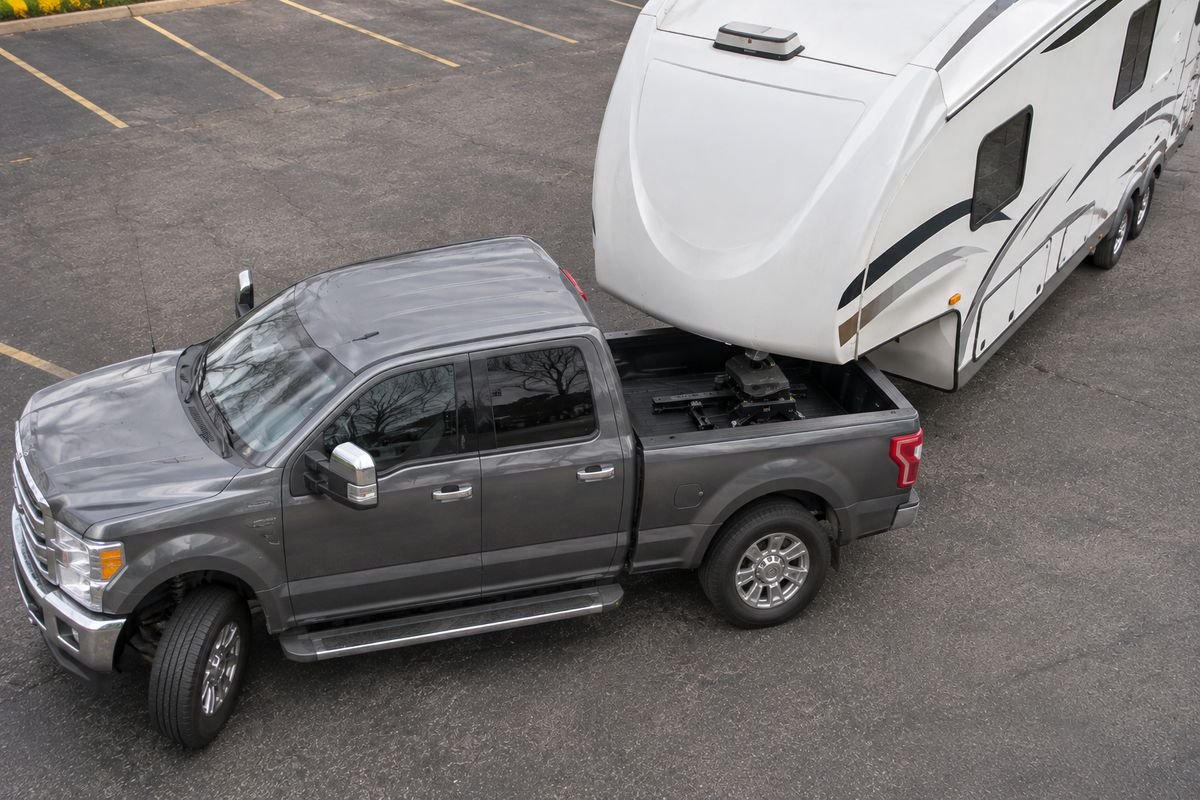
On a short bed, the hitch sits closer to the cab. In a sharp turn, the front corner of the trailer can swing into the back of the cab. A slider moves the hitch back, giving the trailer more room.
- Manual sliders, such as the B&W Companion OEM Slider, lock in a tow position and a maneuver position. You stop, move the handle, and pull forward before a tight turn. B&W says the maneuver position is for slow, tight turns only.
- Automatic sliders, such as the PullRite SuperGlide, move on their own as you turn. The SuperGlide needs a PullRite capture plate on the trailer.
- Pin box changes are another option. Some owners use an extended or pivoting pin box on the trailer instead of a slider. Check with the trailer maker first.
How to hitch up safely
- Set the height. The hitch plate should sit just under the trailer pin box so the trailer stays about level once coupled.
- Lubricate the plate if your hitch needs it. B&W says to grease the top plate or use a lube plate. CURT ships its A16 with a poly lube plate. PullRite says not to use a lube plate on the SuperGlide. Follow your hitch maker.
- Back in slowly. Open the jaws, line up the kingpin, and back until the jaws close.
- Check the lock. Make sure the handle is closed, and the safety pin is in.
- Do a pull test. B&W says to set the trailer brakes, chock the trailer wheels, and gently pull forward. The trailer should stop the truck.
- Connect the breakaway cable and the power cord. Raise the landing gear fully before you drive.
If you also tow a travel trailer, our guide to the weight distribution hitch for travel trailers covers that setup.
Frequently asked questions
What is the best fifth wheel hitch?
It depends on your truck. For 2020 to 2026 GM heavy-duty trucks with factory pucks, the B&W Companion OEM 20K is our top pick. Short bed trucks should look at a slider, such as the B&W Companion OEM Slider or the PullRite SuperGlide.
What size fifth wheel hitch do I need?
Choose a hitch rated at or above your trailer's GVWR, not its empty weight. Then check the pin weight rating. Ram says fifth wheel pin weight is usually 15 to 25 percent of the trailer weight.
Do I need a sliding fifth wheel hitch?
If you have a short bed of about 6.5 feet, most likely yes. CURT says short bed trucks need extra cab clearance when turning and suggests a sliding hitch. Most 8-foot beds have enough room, but check your trailer nose shape and turning clearance.
What is a puck system?
A puck system is a set of mounting points built into the truck frame under the bed by the truck maker. Puck hitches fit into them with no drilling. Ford, GM, and Ram each use their own design, so buy a hitch made for your truck.
Does a fifth wheel hitch need grease?
Some do. B&W says to grease the top plate or use a lube plate, and CURT ships the A16 with a poly lube plate. PullRite says not to use a lube plate on the SuperGlide. Follow the instructions for your hitch.
Can I use a fifth wheel hitch with a gooseneck ball?
Yes, with a gooseneck-mounted design such as the Andersen Ultimate 5th Wheel Connection, which locks onto a gooseneck ball in the bed. You can also use a fifth wheel-to-gooseneck adapter on the trailer, but check with the trailer maker first.
Where to go next
The best fifth wheel hitch fits your truck's mount, carries your trailer's GVWR and pin weight, and gives your bed enough turning room. Start with your truck's payload and towing ratings, then choose the mount type, then the hitch. Ask the installer or the hitch maker to confirm the fit for your exact truck before you tow.