
An RV drinking water hose carries every glass of water, pot of coffee, and shower from the campground spigot into your RV. It looks like a white or blue garden hose, but it is built and certified for drinking water. Pick the wrong one, and you can end up with a plastic taste, a weak shower, a hose that kinks every time you park, or worse, lead in your water.
Restful RV is a participant in the Amazon Services LLC Associates Program, an affiliate advertising program designed to provide a means for sites to earn advertising fees by advertising and linking to Amazon.com.
This guide covers six RV drinking water hoses worth a look, what the NSF labels on the package mean, 1/2 inch versus 5/8 inch, how much hose to carry, the order to hook everything up, how to clean and store the hose, when to replace it, and how to fix the problems people run into most. There is also a planner that works out which hose lengths reach your site with the fewest connections.
Quick answer
For most RVers, a 25-foot, 5/8-inch hose certified to NSF/ANSI 61 is the right buy, such as the Camco TastePURE. NSF/ANSI 61 covers what can leach from the hose into your water, and NSF/ANSI 372 covers lead only, so look for both. Add a 10-foot or 4-foot leader for odd sites, a pressure regulator at the spigot, and keep the hose drained, capped and away from your sewer gear.
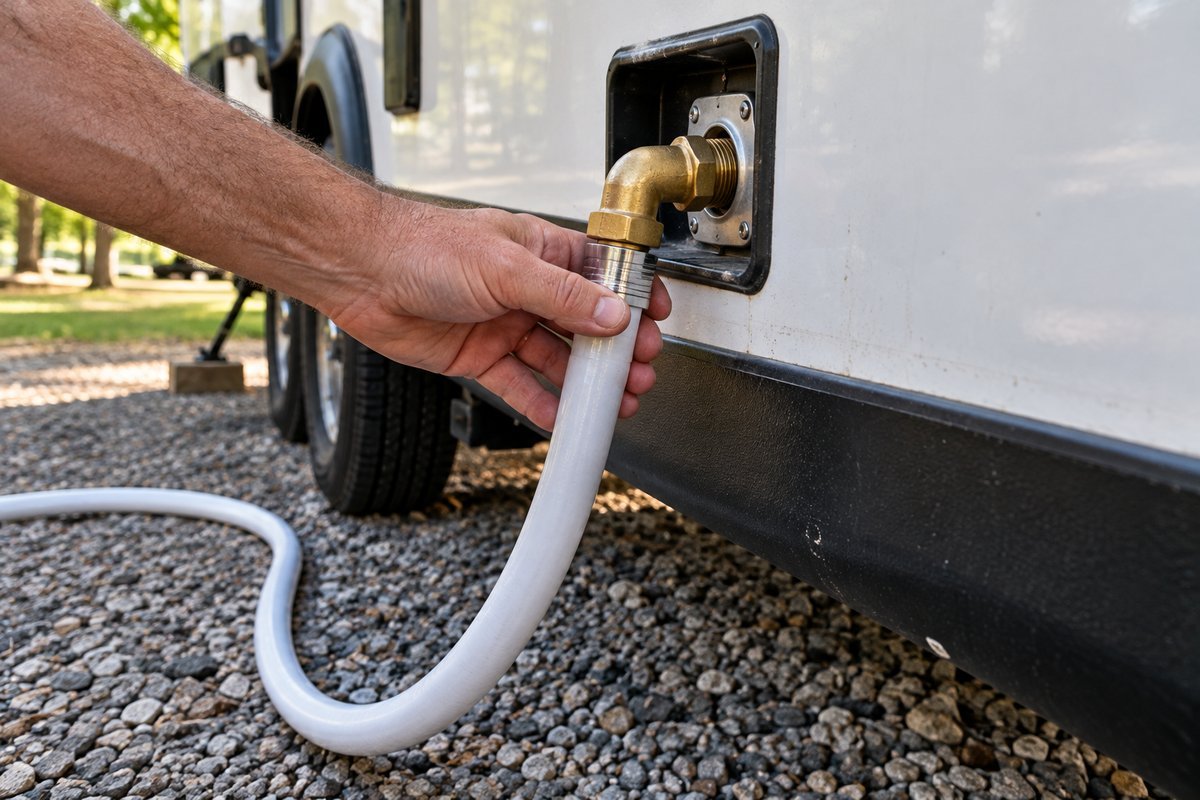
Table of Contents
6 RV Drinking Water Hoses Worth a Look
Every hose below is sold for drinking water and was in stock on Amazon when we wrote this guide. We have not tested these hoses ourselves. The picks are based on what each manufacturer states about certification, size, and construction, and on which hoses come up again and again in the RV guides we checked. Where a manufacturer names an NSF standard, we say which one, because many guides leave it out.
Camco TastePURE 25 ft Drinking Water Hose
Best overallThis hose comes up in most of the RV guides we checked, and Camco names both NSF standards for it. In its RV accessories catalog, Camco says its TastePURE drinking water hoses are certified to NSF/ANSI/CAN 61 for drinking water and CSA lead free content certified to NSF/ANSI 372. Camco also lists them as free of BPA and phthalates.
This model is the 25-foot hose with a 5/8-inch inside diameter (Camco part 22783). Camco says the PVC hose is reinforced for kink resistance and UV stabilized, and it is made in the USA. At 25 feet it covers most campsites without much extra hose lying in the sun.
What You'll Love
- Both NSF standards named by Camco
- 5/8-inch bore for good flow
- Made in the USA
Worth Considering
- PVC stiffens in cold weather
- Can still kink if bent sharply at the inlet
- Needs a good flush before the first drink
Camco TastePURE Professional Grade 50 ft
Best for long reachWhen the spigot is across the site or the fill station is a long way from your inlet, this is the longer, heavier version of the pick above. Camco lists the same NSF/ANSI 61 hose certification and CSA certification to NSF/ANSI 372.
Camco says this professional grade hose has a wall 20 percent thicker than its premium hoses and calls it zero memory, meaning it should lie flat instead of springing back into the coil it was stored in. It has a 5/8-inch inside diameter, which matters more on a 50-foot run than on a short one.
What You'll Love
- Reaches far spigots without joining hoses
- Camco says the wall is 20 percent thicker
- Sold as zero memory, so it should lie flat
Worth Considering
- A 50-foot hose takes more room to store
- More hose means more water sitting in it between uses
- More length than most full hookup sites need
Teknor Apex NeverKink RV and Marine Hose
Best kink resistanceIf your inlet sits low and the hose has to bend hard right at the coupling, kinks are the problem you are trying to solve. Teknor Apex's Amazon listing says its NTS Reflex Mesh eliminates kinks, twists and tangles, and that the Grip Tite coupling gives a leak free attachment at the faucet.
On its own product page, Teknor Apex calls the hose drinking water safe, made with FDA sanctioned materials, and compliant with the Consumer Product Safety Improvement Act for lead. It is made in the USA with a lifetime guarantee. Neither the product page nor the listing names NSF/ANSI 61 or 372, so if a named NSF certification matters to you, one of the Camco hoses is the clearer choice.
What You'll Love
- Built specifically to resist kinks
- Lifetime guarantee from Teknor Apex
- Also sold in 25-foot and 75-foot lengths
Worth Considering
- No NSF standard named
- Heavier than fabric hoses
- Lead claim is CPSIA, not NSF/ANSI 372
Camco EvoFlex2 25 ft Drinking Water Hose
Best for small storageStorage space is the real limit in many RVs, and a stiff PVC hose takes up a whole bin. The EvoFlex2 uses a polyester fabric outer layer, and Camco says its fabric design helps it hold its shape and store in less space than a standard hose. It comes with a storage bag.
Camco lists it as CSA lead free certified to NSF/ANSI 372 with a 5/8-inch inside diameter. The listing we checked did not name NSF/ANSI 61, which is the standard for what can leach from the hose into the water.
What You'll Love
- Packs small and comes with a bag
- Fabric outer layer instead of stiff PVC
- Lead content certified to NSF/ANSI 372
Worth Considering
- NSF/ANSI 61 not named on the listing
- Let the fabric dry before you pack it away
- Do not park on it or run it under a tire
Valterra AquaFresh High Pressure Hose
Best budget pickValterra is one of the big names in RV plumbing parts, and the AquaFresh is its everyday drinking water hose. Valterra says it is engineered for 160 psi RV hookups, uses Hi Flow fittings, and includes a hose gripper to make tightening at the RV easier.
The listing says it is made from NSF listed materials that conform with federal and state laws for drinking water fixtures. It does not name a specific NSF standard, and this size is 1/2 inch by 25 feet, so flow over long runs is lower than a 5/8-inch hose.
What You'll Love
- Rated for high pressure hookups (still use a regulator)
- Gripper helps at tight inlets
- 1/2-inch hose is lighter than 5/8 inch
Worth Considering
- No specific NSF standard named
- 1/2-inch bore flows less on long runs
- A regulator is still needed
Camco Heated Drinking Water Hose 25 ft
Best for winterIf you camp where nights drop well below freezing, a regular hose will freeze solid and can split. Camco says this heated hose (part 22911) protects down to minus 20 F with an energy saving thermostat, and its catalog lists a 6-foot, 18-gauge power cord and an adapter that lets you connect the water source to either end of the hose.
Camco's listing says the hose is NSF/ANSI 61 certified and CSA certified to NSF/ANSI 372. Camco also sells a version rated to minus 40 F with a self regulating cable. Either way, the heated hose only protects itself. The campground spigot and your RV inlet still need insulation, which we cover below.
What You'll Love
- Built in thermostat saves power
- Both NSF standards named on the listing
- Either end can face the spigot
Worth Considering
- Needs a working outlet all winter
- Costs more than a plain hose
- Does not protect the spigot or the RV inlet
Swipe the table sideways to see every column.
| Hose | Length | Inside diameter | NSF/ANSI 61 named | Lead content claim | Best for |
|---|---|---|---|---|---|
| Camco TastePURE | 25 ft | 5/8 in | Yes | NSF/ANSI 372 (CSA) | Most RVers |
| Camco TastePURE Professional | 50 ft | 5/8 in | Yes | NSF/ANSI 372 (CSA) | Far spigots |
| Teknor Apex NeverKink | 50 ft | 5/8 in | No | CPSIA lead-free | Kink-prone inlets |
| Camco EvoFlex2 | 25 ft | 5/8 in | No | NSF/ANSI 372 (CSA) | Small storage |
| Valterra AquaFresh | 25 ft | 1/2 in | No | NSF listed materials | Tight budgets |
| Camco Heated Hose | 25 ft | Not listed | Yes | NSF/ANSI 372 (CSA) | Freezing nights |
"Named" means the standard appears in the manufacturer's product listing we checked. A hose without a named standard is not necessarily unsafe. It means you are relying on the manufacturer's general claim instead of a specific certification you can look up.
What Do NSF/ANSI 61 and NSF/ANSI 372 Mean on a Hose?
These are the two labels worth looking for, and they answer different questions. Some hose packages and guides mention "NSF" without saying which standard, which tells you very little.
- NSF/ANSI/CAN 61 is about what leaches into the water. NSF describes it as setting minimum health effects requirements for chemical contaminants that products in contact with drinking water add to the water. Hoses are one of the product types NSF lists under the standard.
- NSF/ANSI/CAN 372 is about lead content only. NSF states that the standard addresses lead content only, with a maximum of 0.25 percent lead for most components, figured as a weighted average across the surfaces the water touches, and 0.2 percent for solder and flux. That 0.25 percent figure matches the federal definition of lead-free that the EPA describes under the Reduction of Lead in Drinking Water Act of 2011.
So a hose certified to 372 has very little lead in the parts the water touches, but 372 alone says nothing about other chemicals. A hose certified to 61 has been evaluated for what it adds to the water. The strongest label you will find on an RV hose names both, so check for each one.
How to Read a Hose Label
- "Certified to NSF/ANSI 61" or "NSF/ANSI/CAN 61": the best sign. Look for the certifier's name, such as NSF or CSA.
- "Certified to NSF/ANSI 372" or "lead free": good for lead, silent on everything else.
- "Made with NSF listed materials" or "FDA sanctioned materials": a general claim about the ingredients, not a certification of the finished hose.
- "Drinking water safe" with no standard named: the manufacturer's word, which may be true but is the hardest to check.
- "Lead free couplings" only: covers the fittings, not the hose itself.
- A California Proposition 65 warning: a sign to keep looking if the hose is for drinking water.
Can You Use a Regular Garden Hose for RV Drinking Water?
You can, but you should not. Garden hoses are not made for drinking water, and testing has found things in them you would not want in your coffee.
In its 2016 garden hose study, the Ecology Center tested 32 hoses. It found that 7 of the 24 PVC hoses contained at least 100 parts per million of lead, and phthalates turned up in 18 of the 24. When the lab tested water from six of the hoses, it found lead in three, at 13, 19, and 20 parts per billion. At the time, the EPA action level for lead in public water systems was 15 parts per billion. The top-rated hoses in that study were all polyurethane, not PVC.
The Ecology Center's advice aligns with what RVers need: buy hoses labeled drinking water safe, avoid hoses with a Proposition 65 warning, let the water run for a few seconds before you drink, and keep hoses in the shade because heat increases leaching. A dedicated drinking water hose also never gets used to rinse out a holding tank, wash the truck, or water a garden, which keeps it clean in a way no label can.
Is a 1/2-inch or 5/8-inch hose better for an RV?
For most RVs, a 5/8-inch hose is the better default, and the difference really matters only on long runs. A wider hose has less friction, so it delivers more water at the far end. Iowa State University Extension publishes flow figures for a 100-foot hose: at 50 psi, a 1/2-inch hose delivers about 7 gallons per minute and a 5/8-inch hose about 12. The same page notes that the flow from any hose drops as its length increases.
Your RV will not use anything close to those numbers, because the pressure regulator and the RV's own plumbing set the real limit. So on a 25-foot run, the difference between the two sizes is usually small. A 5/8-inch hose earns its place on a 50-foot or longer run, with two hoses joined, or when filling the fresh tank, where faster flow saves time. A 1/2-inch hose is lighter and coils smaller, making it a reasonable choice for short leaders. Airstream's city water guidance for its touring coaches calls for a tasteless, odorless, nontoxic, high-pressure hose of at least 1/2-inch diameter.
No matter the size you buy, the fittings are the same. RV hoses use standard 3/4-inch garden hose thread, so a 1/2-inch hose and a 5/8-inch hose screw onto the same spigot, regulator, and inlet.
How Long Should an RV Drinking Water Hose Be?
Long enough to reach the spigot with a little slack, and no longer. Extra hose costs you in three ways. It holds more water that sits warm between uses, it adds friction that lowers pressure at the far end, and it is one more thing to coil, drain, and store.
Most RVers do best with a 25-foot hose as the main line plus one or two short leaders, which are short extra lengths of hose. A 10-foot section covers times when the spigot is a little too far, and a 4-foot leader is handy when the spigot is right beside your inlet, or between a water filter and the RV. Joining two short hoses beats dragging out a 50-foot hose for a 12-foot reach. Keep a 50-foot hose for the sites, fill stations, and long driveways that need it.
RV Hose Length Planner
Measure the distance from the spigot to your city water inlet along the ground where the hose will run, then enter it below.
How much hose do you need?
Measure from the campground spigot to your RV's city water inlet along the path the hose will lie, not in a straight line. The planner adds slack and picks the fewest hoses from common lengths that reach.
The planner only does length math. It picks the combination with the fewest connections and the least extra hose, because every joint is one more washer that can leak. Your regulator, filter and elbow go between the hoses or at the ends and do not count toward length.
RV hose length planner by Restful RVrestfulrv.com
How Do You Hook Up an RV Drinking Water Hose?
The order matters more than any single part. Put the pieces on in this sequence, starting at the spigot.
- Run the spigot for a few seconds first. This clears dirt and stale water from the campground line before anything touches your gear.
- Pressure regulator on the spigot. Putting it first protects everything downstream, including the hose and the filter, from high campground pressure. Our RV water pressure regulator guide explains why most manufacturers land around 45 to 50 psi.
- Water filter next, if you use one. An inline filter screws on after the regulator. See our RV water filter guide for what each type removes.
- Your drinking water hose. Check that the rubber washer is seated in each female coupling before you thread it on.
- A 90-degree elbow at the RV inlet. A brass elbow lets the hose hang straight down instead of bending sharply at the coupling, which is where most kinks and cracked fittings start.
- Hand-tighten every connection. Hose washers seal by compression, so a firm hand turn is usually enough. Pliers can crack plastic couplings and crush the washer.
Open the spigot slowly and look at each joint for drips before you walk away. If you also fill your fresh tank, use the same clean hose and the same order, then switch the RV from city water to tank fill using its own valve or fill port.
Why Does Water From a New Hose Taste Like Plastic?
Many drinking water hoses are PVC, and a brand-new one can give the first water that passes through it a plastic taste or smell. Heat makes it worse. Water that sits in a hose in the sun warms up, and the Ecology Center notes that heat from the sun can increase chemical leaching into the water. Camco's catalog says its TastePURE hoses deliver water with no plastic taste, but any hose benefits from the same few habits.
- Flush a new hose before the first drink. Connect it to a spigot and run water through it for several minutes, then drain it.
- Run the water for a few seconds before every use. This pushes out the water that sat in the hose since you last used it.
- Keep the hose out of direct sun. Lay it in the shade of the RV, or under the slide or the skirting if you have it.
- Use only as much hose as you need. Less hose means less water sitting and warming in it.
- Filter after the hose if the taste stays. A carbon filter also reduces chlorine taste from the campground supply. See our RV water filter guide.
How Do You Clean and Store an RV Drinking Water Hose?
Keep a drinking water hose clean by never letting it touch anything dirty. Do these every time you pack up.
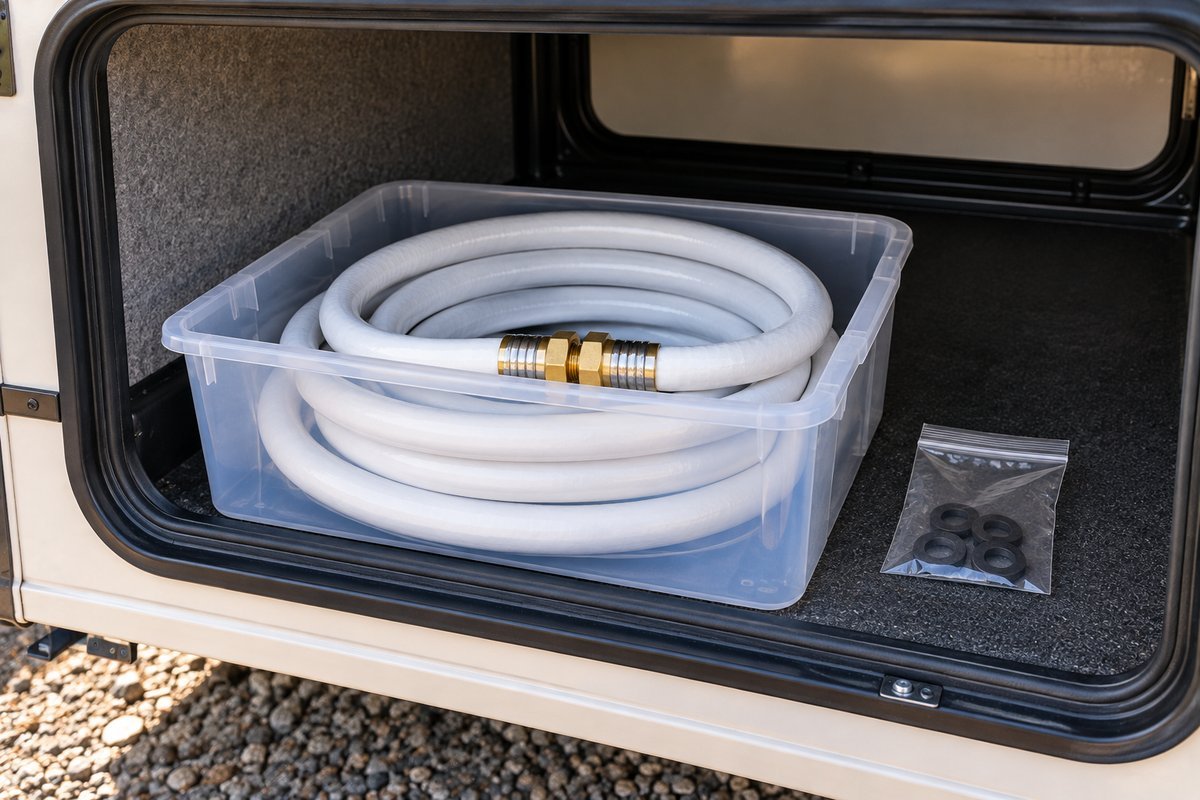
- Drain it completely. Disconnect both ends, lift one end, and walk the hose up as you coil it so the water runs out the other end. Iowa State University Extension recommends draining hoses before cold weather because trapped water freezes and expands.
- Close the ends. Screw the two ends together to make a loop, or use hose end caps. This keeps out dirt, insects and anything else that crawls into an open hose.
- Store it away from your sewer gear. Never in the same bin or compartment as the sewer hose, the sewer hose support or the gloves you use for dumping. Our RV sewer hose guide covers the dirty side of the system.
- Keep it out of the sun. Iowa State notes that putting hoses away reduces UV damage, and that vinyl hoses are more affected by UV light.
- Coil it loosely. Tight coils train a hose to kink. A loose coil or a figure eight is easier on it.
Sanitizing the Hose
None of the hose makers we checked publish a hose sanitizing method, so the practical approach is to do the hose when you sanitize the rest of your fresh water system. Use the bleach strength and contact time in your RV owner's manual, because manufacturer instructions vary. Leisure Travel Vans, for example, calls for 1/4 cup of bleach per 15 gallons of water and about 2 hours of soaking. Fill the hose with the same solution, close both ends, let it sit for the same amount of time as the tank, then flush it with fresh water until you can no longer smell bleach.
How Often Should You Replace an RV Drinking Water Hose?
No hose maker we checked publishes a replacement schedule, so replace the hose based on condition rather than the calendar. If your hose has a warranty, such as the lifetime guarantee Teknor Apex gives its NeverKink, check it before you buy a new one. Replace it when you see any of these.
- Cracks, splits, or a bulge in the hose wall
- A kink that will not straighten, or a flattened section
- Couplings that are bent, cracked, corroded, or will not seal even with a new washer
- A taste or smell that does not go away after flushing
- Any time it has been used for anything other than drinking water, such as rinsing a tank or washing the RV
- Discoloration or slime inside the hose that sanitizing does not clear
Washers wear out much sooner than hoses. Replace them whenever a coupling drips, and keep a few spares with your hose.
Do You Need a Heated Hose in Cold Weather?
Only if you stay hooked up to city water through nights that drop well below freezing. Water expands as it freezes, and the University of Missouri Extension notes that expanding water can break pipes. A hose full of water is no different. For a night or two around freezing, many RVers simply disconnect the hose, drain it, and run off the fresh tank and the water pump until it warms up.
For longer cold stays, a heated hose keeps water flowing, but it has limits you should know before you buy.
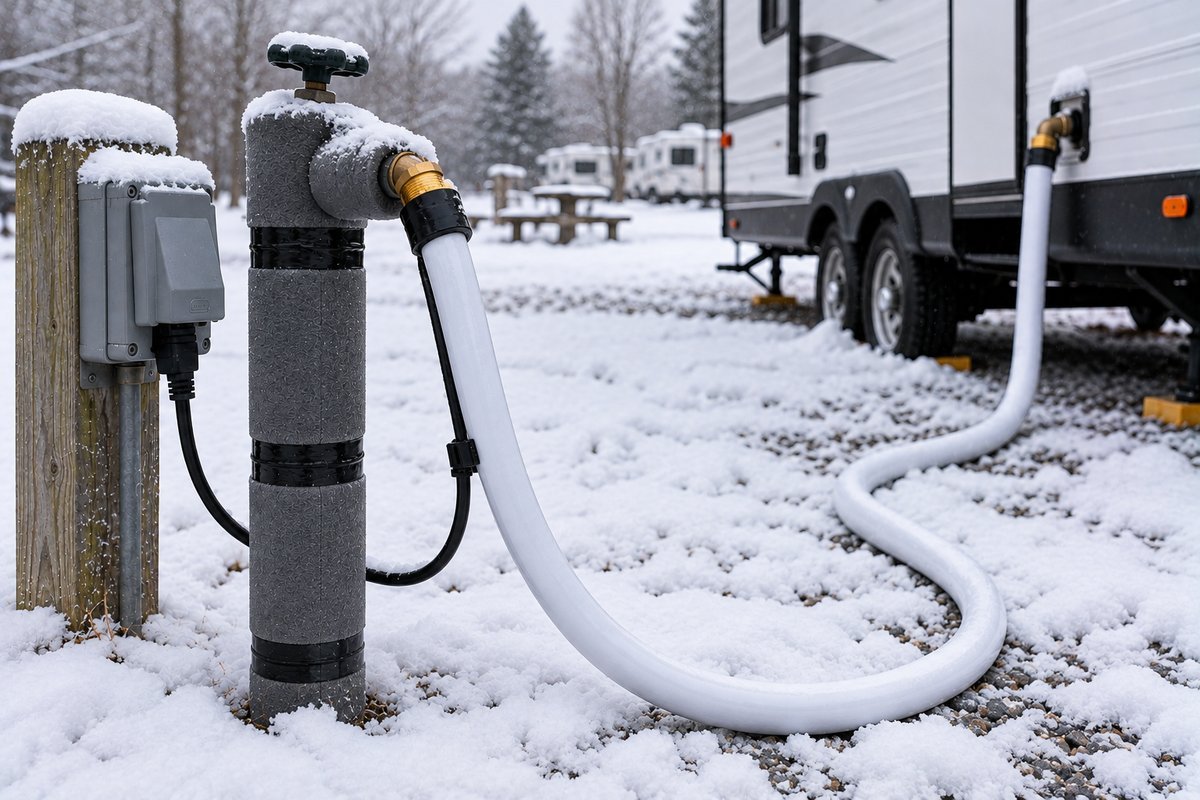
- Check the rating. Camco sells heated hoses rated to minus 20 F and minus 40 F. Buy for the coldest night you expect, not the average.
- Protect the spigot and the inlet. The heated hose does not heat the campground water riser or your RV's water inlet. Insulate the spigot or wrap it with heat tape, and keep your RV's underbelly warm. Our RV skirting guide explains how skirting helps.
- Use a GFCI-protected outlet and follow the manual. Heated hose maker PIRIT, for example, says plainly in its user guide that the hose is not designed to protect your water supply from freezing, and tells owners to plug only into a GFCI-protected circuit and not to use extension cords. Check the instructions for your hose.
- Leave the thermostat in the open air. PIRIT notes that the thermostat must be exposed to the outside temperature to work. Do not bury it under snow or insulation.
- Store it indoors after winter. Drain and unplug it when you're not using it.
If you are putting the RV away for the season instead, see how to winterize an RV.
What Are the Most Common RV Water Hose Problems?
Most hose trouble comes down to a handful of causes. Start with the cheapest fix in each row before you buy anything new.
| Problem | Likely cause | What to do |
|---|---|---|
| Drip at a coupling | Missing, flattened, or hardened washer | Replace the washer and hand-tighten. Washers are cheap, so carry spares. |
| Spray from the hose wall | Split from freezing, sun damage or a crush | Retire the hose. Taping a drinking water hose is not a lasting fix. |
| Weak flow inside the RV | Kink, clogged filter, or a regulator screen full of debris | Straighten the hose, add an elbow at the inlet, then check the filter and the regulator inlet screen. |
| Hose kinks every time you park | Sharp bend at the inlet or a hose stored tightly coiled | Use a 90-degree elbow at the inlet, and store the hose in loose loops instead of a tight coil. |
| Plastic taste or smell | New hose, or water sitting hot in the hose | Flush it well, run the water before drinking, and keep the hose out of direct sun. |
| Hose frozen solid | Overnight temperatures below freezing | Disconnect and use the fresh tank, or switch to a heated hose and insulate the spigot. |
| Hose will not thread on | Cross-threading or a damaged coupling | Back it off and start again by hand. If the threads are flattened, replace the coupling or the hose. |
Quick Answers
Can you use a regular garden hose for RV drinking water?
You can, but you should not. In the Ecology Center's 2016 study, 7 of 24 PVC garden hoses contained at least 100 parts per million of lead, and lead turned up in water from three of the six hoses tested.
What is the difference between NSF/ANSI 61 and NSF/ANSI 372?
NSF/ANSI 61 covers what a product can leach into drinking water. NSF/ANSI 372 covers lead content only, with a 0.25 percent weighted average limit for most components. The strongest RV hose labels name both.
Is a 1/2-inch or 5/8-inch hose better for an RV?
A 5/8-inch hose is the better default because it loses less flow over long runs. On a 25-foot run, the difference is usually small, and a 1/2-inch hose is lighter.
How long should an RV drinking water hose be?
Long enough to reach the spigot with a little slack. Most RVers do best with a 25-foot hose plus a 10-foot or 4-foot leader, and a 50-foot hose for far spigots.
How often should you replace an RV drinking water hose?
No hose maker we checked publishes a schedule, so replace it based on condition: cracks, kinks that will not straighten, damaged couplings, a taste that flushing doesn't clear, or any use other than drinking water.
Do you need a heated hose in cold weather?
Only if you stay on city water through nights well below freezing. A heated hose protects only itself, so the spigot and the RV inlet still need insulation.
Where to Go Next
Your hose is one part of the system. Set the pressure first with an RV water pressure regulator, clean up taste and sediment with an RV water filter, and make sure the tank side keeps up with the best RV water pump. If a fitting gives way while you are away, an RV water leak detector can warn you before the floor soaks up the water.