
When you turn on a faucet while dry camping, the water comes from your RV water pump, a small 12-volt unit hidden under a bed, dinette seat, or bay door. It pulls water from your fresh tank and pushes it to every faucet, the shower, and the toilet. When it quits, hums without moving water, or keeps clicking in the middle of the night, your whole water system stops working.
Restful RV is a participant in the Amazon Services LLC Associates Program, an affiliate advertising program designed to provide a means for sites to earn advertising fees by advertising and linking to Amazon.com.
This guide covers five replacement pumps worth a look, how to size one for your rig, how to fix the most common pump problems, and how to swap a pump yourself.
Quick answer
Most RVs use a 12-volt diaphragm pump that moves about 3 gallons per minute and shuts off at about 50 to 55 psi. The easiest fix for a worn-out pump is the same size from the same maker, such as a SHURflo 4008 or a Lippert Flow Max, because the ports and mounting holes often line up. If you want stronger showers with two taps open, a 4 GPM pump or a variable-speed pump like the Remco Aquajet is the upgrade. Before you replace a pump that will not run, check the fuse, the switch, and the ground wire first.
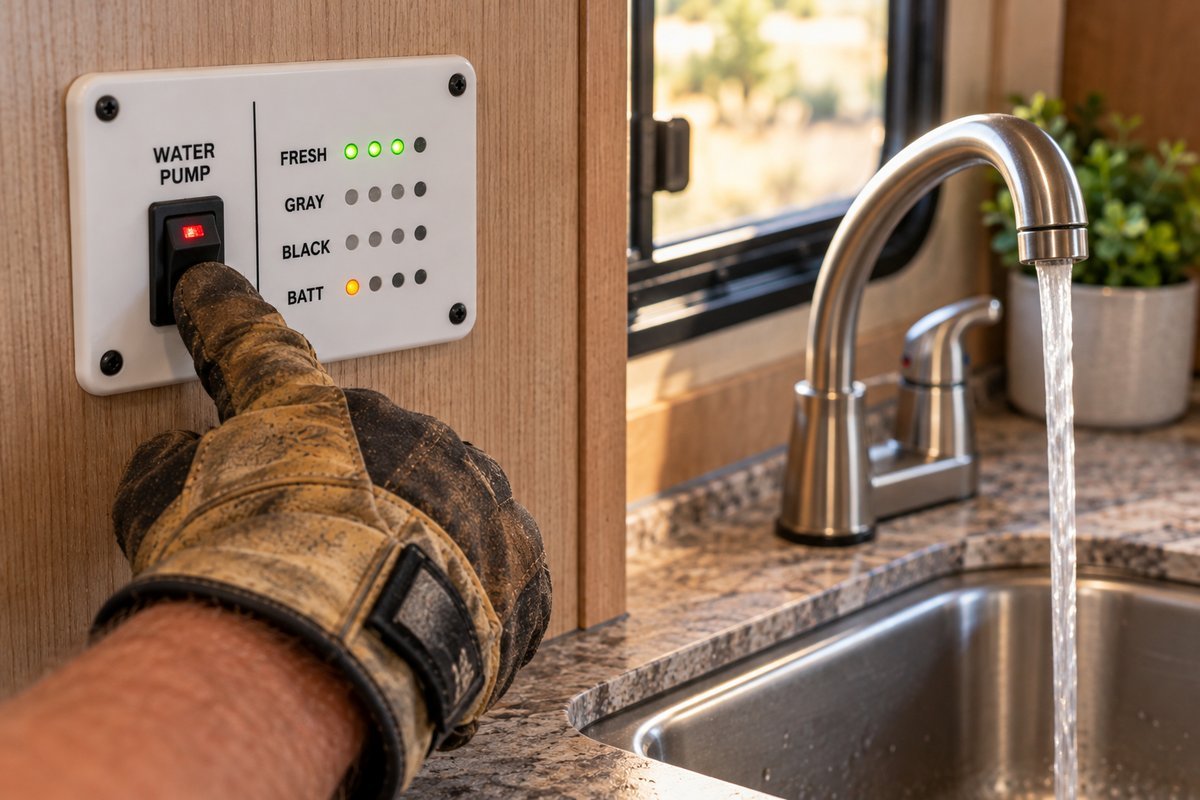
Table of Contents
5 RV Water Pumps Worth a Look
These picks are based on what the makers publish, plus the specs sellers list. We looked at flow, shut-off pressure, current draw, port size, and whether the pump can run dry without damage. We have not bench-tested these pumps.
Specifications note: Makers sometimes sell more than one version under a similar name. Check the model number on the listing and on your old pump's label before you order, and match the voltage to your rig. All five picks here are 12-volt DC pumps.
SHURflo Revolution 4008-101-E65
Best direct replacementThe SHURflo 4008 is a widely sold 3 GPM pump, which makes it an easy swap for a lot of owners. If your old pump is a SHURflo 4008, the new one usually drops into the same spot with the same fittings.
SHURflo's data sheet lists 3.0 gallons per minute with the outlet open and a shut-off of 55 psi. It draws about 2.2 amps with no back pressure and about 6.8 amps at 50 psi, and SHURflo recommends a 10-amp fuse. It can prime itself from about 6 feet below the pump and can run dry without damage. The ports are 1/2 inch male threads. It is rated for intermittent duty, which fits normal RV use.
What You'll Love
- Easy swap for an old 4008
- Can run dry without damage
- Draws less current than the bigger picks
Worth Considering
- Pressure drops with two taps open
- Intermittent duty, not for constant use
- Needs its rubber feet to stay quiet
SHURflo 4048-153-E75 High Flow
Best upgrade for stronger flowIf your shower goes weak the moment someone opens the kitchen tap, the 4048 is the step up. SHURflo rates it at 4.0 gallons per minute with the same 55 psi shut-off, so it keeps pressure up better when two fixtures are open.
It has a four-chamber diaphragm and an internal bypass, which SHURflo says cuts down on cycling at low flow. It self-primes up to 6 feet, can run dry, and has a built-in check valve to stop water from flowing backward. The box includes a strainer and two hose barb fittings. It draws more current than the 4008, up to about 10 amps, and SHURflo recommends a 15-amp fuse, so check that your wiring can handle it.
What You'll Love
- Stronger flow with two taps open
- Less cycling at a slow trickle
- Strainer and fittings included
Worth Considering
- Higher draw uses more battery
- Your wiring may need an upgrade
- More flow than one tap needs
Remco Aquajet ARV 5.3 GPM
Best for big rigs and multiple faucetsThe Remco Aquajet is a variable-speed pump. Instead of running full speed and switching on and off, it speeds up and slows down as you open and close faucets. Retailer listings say the pump adjusts its speed to hold steady pressure, which cuts down on the on-and-off cycling many RV pumps have.
Remco rates the Aquajet at 5.3 gallons per minute, and it uses a five-chamber design. Sellers say it can run up to 4 fixtures at once. Retailers list it at 10 amps, a 140 F maximum water temperature, and 3/4 inch quick-attach ports with adapters. Pressure figures differ between sellers. One lists 60 to 75 psi and another lists 65 psi, so check the label on the one you get.
What You'll Love
- Holds steadier pressure
- Built for several fixtures at once
- Can work without an accumulator tank
Worth Considering
- Higher pressure can stress old plumbing
- May need new fittings for your lines
- More than a small trailer needs
SEAFLO 43 Series 3.0 GPM
Best budget pickSEAFLO's 43 Series pump matches the common 3 GPM and 55 psi spec and is often priced below the SHURflo and Lippert pumps. Check current prices before you buy. It is a good pick for an older trailer or a spare to keep in the storage bay.
The model number is SFDP1-030-055-43. SEAFLO lists 3.0 gallons per minute, a 55 psi shut-off, and an internal bypass to reduce cycling. It self-primes up to about 6 feet and has thermal protection. It comes with 3/4 inch quick-attach fittings and a filter.
What You'll Love
- Often priced below the big RV brands
- Filter and fittings in the box
- Internal bypass to reduce cycling
Worth Considering
- Fittings differ from a SHURflo 4008
- Marine brand, not an RV parts maker
- Current draw not clearly listed
Lippert Flow Max 689052
Best swap for a factory Flow MaxLippert makes the Flow Max. If your rig left the factory with a Flow Max, this is the simplest like-for-like swap.
Lippert lists an average flow of 3.0 gallons per minute, a 50 psi pressure rating, and a maximum draw of 9.5 amps, and says the pump needs a 15-amp circuit. It self-primes, can run dry, and comes with a screen filter. Some sellers list the shut-off at 45 psi instead, so compare it to your old pump's label.
What You'll Love
- Same-brand swap for a factory Flow Max
- Filter included
- Can run dry without damage
Worth Considering
- Needs a 15-amp circuit
- Pressure figure varies by seller
- Fittings may differ from your old pump
RV water pumps compared
On a phone, swipe the table sideways to see every column.
| Pump | Flow | Shut-off | Current draw | Ports |
|---|---|---|---|---|
| SHURflo 4008-101-E65 | 3.0 GPM | 55 psi | Up to 6.8 A at 50 psi | 1/2 inch male |
| SHURflo 4048-153-E75 | 4.0 GPM | 55 psi | Up to 10 A | 1/2 inch male (hose barbs included) |
| Remco Aquajet ARV | 5.3 GPM | Varies by seller (60 to 75 or 65 psi) | 10 A | 3/4 inch quick-attach |
| SEAFLO 43 Series | 3.0 GPM | 55 psi | Not clearly listed | 3/4 inch quick-attach fittings included |
| Lippert Flow Max 689052 | 3.0 GPM | 50 psi rating (some sellers list a 45 psi shut-off) | 9.5 A max | Not listed by Lippert |
How an RV Water Pump Works
Most RVs use a 12-volt diaphragm pump with a pressure switch. When you open a faucet, line pressure drops, the switch closes, and the pump starts. When you close the faucet, pressure builds back up to the shut-off point, and the switch turns the pump off.
That is why you hear the pump run for a second or two when nobody is using water. A small pressure drop from a tiny leak or slow drip is enough to turn it back on. The pump only runs on battery or converter power, so it is what gives you water when you are not hooked up to a campground spigot.
When you are hooked up to city water, the campground's pressure feeds your lines directly, and the pump is not needed. Switch the pump off while connected, and use an RV water pressure regulator at the spigot to protect your plumbing.
How to Pick the Right Pump
Flow rate
Flow is measured in gallons per minute, or GPM. A 3 GPM pump is a common size and works well when only one faucet is open at a time. If your household often runs the shower and kitchen sink at the same time, a 4 GPM pump helps. A variable-speed pump like the Remco Aquajet is designed for larger rigs with more fixtures.
More flow is not always better. A bigger pump uses more battery power. With the taps wide open, it can also drain your fresh tank faster, which matters when you camp without hookups.
Shut-off pressure
Most RV pumps shut off around 50 to 55 psi. Higher pressure can feel better in the shower, but older plumbing, plastic fittings, and some faucets are not built for it. If you upgrade to a higher-pressure pump, check your fittings for leaks over the first few trips. An RV water leak detector under the sink or near the pump can catch a slow drip early.
Current draw and wiring
Check the maximum amp draw and the fuse or circuit the manufacturer calls for. The SHURflo 4008 calls for a 10-amp fuse, the higher-flow SHURflo 4048 calls for a 15-amp fuse, and Lippert says the Flow Max needs a 15-amp circuit. If you move up to a bigger pump, make sure the wire and fuse in your rig match what the new pump needs.
Ports and fittings
Fittings cause the most trouble in a swap. Some pumps have 1/2 inch threaded ports, and others use 3/4 inch quick-attach ports with snap-in fittings. Take a photo of your old pump's ports and fittings before you order, and plan to buy adapters if the new pump uses a different style.
Troubleshooting a Bad RV Water Pump
When a pump acts up, the pump itself is often fine. Most of the steps below come from SHURflo's troubleshooting guide, and they start with cheap, easy checks.
The pump will not run
- Check the fuse. Look in your RV's 12-volt fuse panel for the pump fuse.
- Try every switch. Many RVs have more than one pump switch, often at the monitor panel, in the bathroom, and at the outside service center.
- Check the ground. A loose or corroded ground wire is a common cause.
- Check the voltage. A weak battery can keep the pump from starting. SHURflo says to check for the correct voltage, within 10 percent, and a good ground.
- Let it cool. Many pumps have a thermal breaker that shuts them off when hot, then resets once they cool down.
- Think about freezing. If the pump sat in freezing weather with water in it, the diaphragm or housing may be damaged.
The pump runs, but no water comes out
- Make sure the fresh tank actually has water in it.
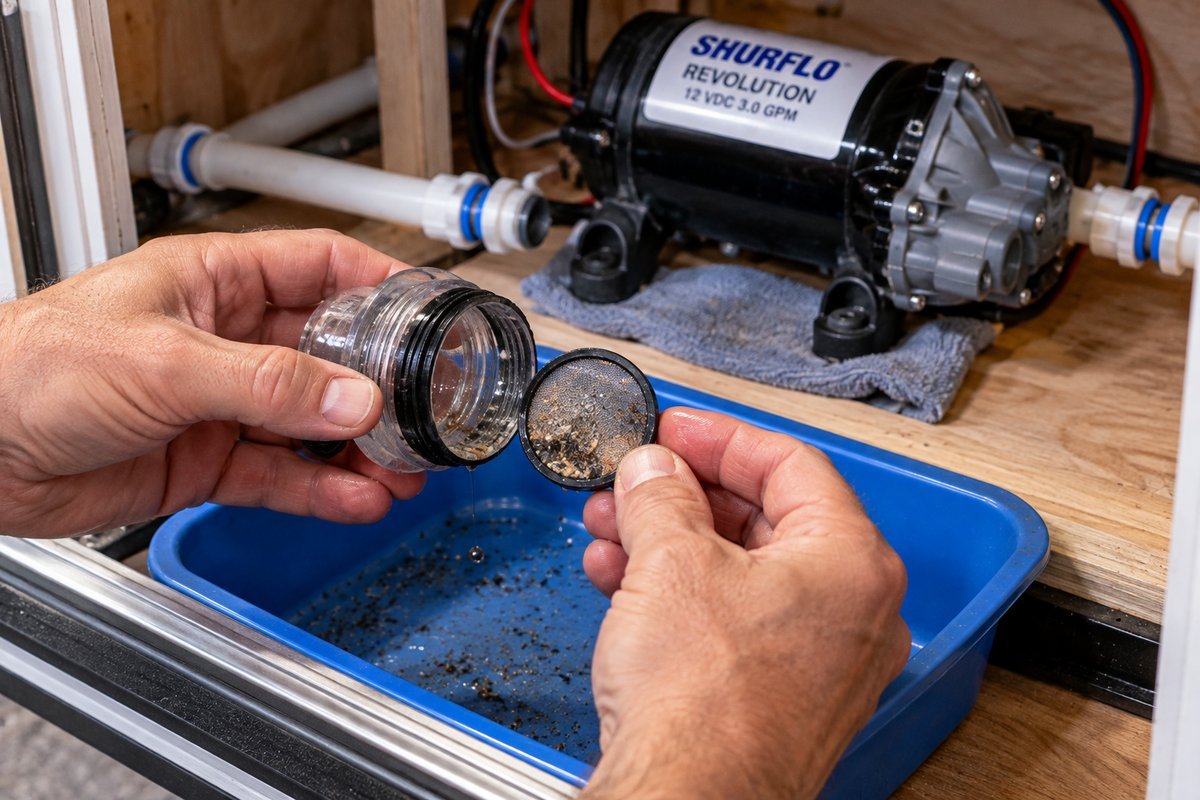
- Clean the strainer on the pump's inlet. A clogged screen cuts off the water supply to the pump.
- Check that your winterizing bypass valves are back in their normal position.
- Look for an air leak on the inlet side, such as a loose hose clamp or a cracked fitting. The pump will suck air instead of water.
- Check for kinked or crushed hoses between the tank and the pump.
The pump keeps turning on and off
If the pump cycles quickly while a faucet is open, a restriction is often the cause, such as a clogged faucet screen or a water filter on the same line. If the pump turns on for a moment when all the faucets are closed, water is leaking somewhere and pressure is dropping. Check under sinks, behind the toilet, at the water heater, and at the outside shower. Our RV water filter guide covers filter setups that do not restrict the flow.
The pump will not shut off
A pump that keeps running with every tap closed either has a leak on the outlet side or cannot reach its shut-off pressure. Look for water under the RV and around fittings. Air trapped in the lines can also do it, so open each faucet, hot and cold, until the water runs smoothly.
The pump is too loud
Most pump noise is vibration carried into the floor. Check that the mounting screws are snug but not crushing the rubber feet. Short lengths of flexible hose between the pump and hard plastic lines also help. Do not connect a pump directly to rigid pipe.
The pump runs while on city water
If your pump runs when you are hooked up to city water, RV Travel's Dave Solberg says the check valve is likely bad or stuck. He suggests replacing the pump's check valve and filter. Until then, turn the pump switch off whenever you are connected. Your city water inlet may also have its own check valve worth checking.
Do You Need an Accumulator Tank?
An accumulator is a small tank with an air bladder that sits on the pump's outlet side. It stores a small amount of pressurized water, so the pump runs less often and the flow is smoother. It is not required, but it can quiet a pump that pulses or cycles a lot.
SHURflo's accumulator manual says to install it after the pump and before any filters or check valves. Set the air charge equal to the pump's turn-on pressure, and check it with the pump off and a faucet open. In SHURflo's example, a 45 psi pump turns on at about 30 psi, so the tank gets a 30 psi charge.
How to Replace an RV Water Pump
Swapping a pump is a common do-it-yourself job. Plan for an hour or two, longer if the pump is in a tight spot.
- Turn off power. Switch the pump off and pull its fuse.
- Relieve pressure. Open a faucet to release pressure, and keep a towel and a small pan under the pump.
- Take photos. Take pictures of the wiring and hoses so you know what goes where.
- Disconnect. Remove the inlet and outlet hoses, then the two wires. Note which wire is positive.
- Remove the old pump. Unscrew the mounting screws and lift it out.
- Mount the new pump. Set it on its rubber feet and snug the screws without crushing them.
- Connect the plumbing. Put the strainer on the inlet side. Use the fittings that came with the pump, or adapters if your lines are a different size.
- Connect the wires. Match positive to positive and ground to ground, and replace the fuse.
- Test. Turn the pump on, open each faucet until the air is out and the water runs steady, then close them all. The pump should shut off and stay off. Check every fitting for drips.
Keep Your Pump Healthy
Check the inlet strainer regularly. A clogged strainer is one of the first things SHURflo says to check when a pump will not prime.
Sanitize your fresh water system before you store the RV and again before you use it after storage. In an article on the Recreation Vehicle Dealers Association website, SHURflo calls a lack of maintenance, including sanitizing and winterizing, the number one cause of pump trouble.
When you winterize, drain the pump or run RV antifreeze through it. Never use automotive antifreeze in your fresh water system. Our guide on how to winterize an RV walks through every step, and a freeze alarm can warn you if the bay drops below freezing.
Quick Answers
What size water pump do I need for my RV?
Most RVs do fine with a 3 GPM pump that shuts off at about 50 to 55 psi. If you often run two fixtures at once, a 4 GPM pump helps. Larger rigs with several bathrooms may want a variable-speed pump. Match the voltage, ports, and mounting space of your old pump.
Why does my RV water pump turn on by itself?
Pressure in the lines is dropping, usually from a small leak or a dripping faucet. Check under sinks, behind the toilet, at the water heater, and at the outside shower. If it cycles fast while a tap is barely open, a pump with an internal bypass or an accumulator tank can smooth that out.
Can an RV water pump run dry?
Many can. SHURflo and Lippert say their pumps in this guide can run dry without damage, and retailer listings say the same for the Remco Aquajet. Running dry for a long time still wears the pump and drains your battery, so turn it off if the tank is empty.
Should the water pump be on when connected to city water?
No. Turn the pump off when you are hooked up to city water. The campground pressure supplies your lines. If the pump runs while connected, the check valve may be bad.
How long does an RV water pump last?
There is no set lifespan. Pumps last longer when you clean the strainer, sanitize the water system before and after storage, and protect the pump from freezing. A pump that sits wet through a freeze can crack.
Where to Go Next
If you are working on your RV's water system, start with an RV water pressure regulator for campground hookups and an RV water filter for better-tasting water. If you are replacing fixtures too, see our guides to the best RV kitchen faucet and the best RV shower head.