
An RV carbon monoxide detector warns you when exhaust gas builds up inside your camper. Carbon monoxide (CO) has no color, smell or taste, so the alarm is the only way you will know it is there. Most RVs built in recent years come with one from the factory, usually built into a combined CO and propane alarm mounted low on a wall near the kitchen. That alarm only protects you if it is in the right spot, still inside its service life, and not unplugged because it kept beeping.
Restful RV is a participant in the Amazon Services LLC Associates Program, an affiliate advertising program designed to provide a means for sites to earn advertising fees by advertising and linking to Amazon.com.
This guide covers where to mount an RV CO detector, how to test it, what to do when it goes off, how to tell a real alarm from a low battery chirp, when to replace it, and which detectors to buy. Everything here comes from the alarm makers' manuals and federal safety agencies, listed at the end.
Quick Answer
Every RV with a furnace, water heater, propane fridge, stove or generator needs a working CO alarm. The usual setup is a 12-volt combined CO and propane alarm mounted 4 to 20 inches above the floor in the kitchen area, plus a second CO alarm near the bed. Test it weekly while you are using the RV, before each trip and after storage. The common Safe-T-Alert LP/CO alarms must be replaced within 5 years of the date they were made, so check the date on the back. If it sounds a CO alarm, get everyone outside into fresh air and call 911.
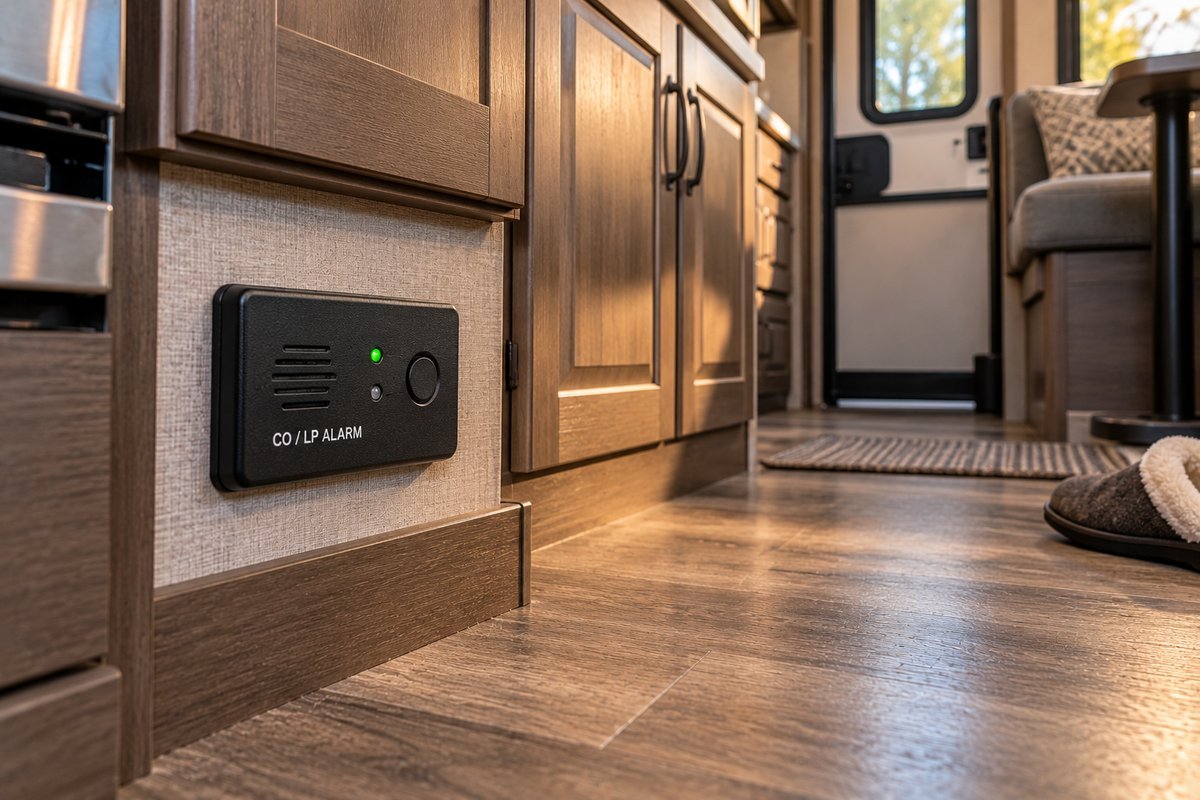
Table of Contents
Why an RV Needs Its Own CO Alarm
Carbon monoxide comes from anything that burns fuel. In an RV, that list is longer than most people think. According to the CDC, more than 400 people in the United States die each year from carbon monoxide poisoning that is not linked to a fire, and more than 14,000 are hospitalized.
These are the common CO sources in and around an RV:
- The furnace and water heater. Both burn propane and push exhaust out through vents on the side of the RV. A cracked burner chamber or a blocked vent can send exhaust back inside.
- The propane fridge. On gas, a fridge is a burning appliance with its own vent, like the furnace.
- The stove and oven. A burner that is running well gives off a small amount of CO. One that is dirty or badly adjusted gives off much more.
- Your generator, and your neighbor's. Generator exhaust can drift in through a window, a roof vent or a gap under the RV. In a crowded campground, the next-door generator counts too.
- Running engines. A motorhome idling with the generator or engine exhaust trapped under it, or a truck left running next to an open door.
- Portable heaters and camp stoves. Any fuel-burning heater or stove used inside.
Size is what makes an RV different from a house. The Escapees RV Club gives an example of a broken unvented gas heater that might raise CO to about 30 parts per million (ppm) in a 1,680-square-foot home but to 200 ppm or more in a 200-square-foot RV. The same leak is far more dangerous in a small space.
The CDC lists the first symptoms as headache, dizziness, weakness, upset stomach, vomiting, chest pain, and confusion, often described as "flu-like." It also warns that people who are asleep can die before they ever feel sick. That is why the alarm matters most at night, when the furnace is running, and everyone is in bed.
CO Alarm vs Propane Alarm: What Each One Does
RVs need protection from two different gases, and they behave differently.
- Carbon monoxide comes from burning fuel. It mixes into the room air, so a CO sensor works at any height. It poisons you by taking the place of oxygen in your blood, and high levels can knock you out in minutes.
- Propane is the fuel itself, and it can leak before it burns. It is heavier than air and settles toward the floor. That is why propane alarms are mounted low. The danger is fire or explosion, not poisoning.
Most newer RVs have a combined CO and propane alarm, often shortened to an LP/CO alarm (LP stands for liquefied petroleum, which is propane). One unit with two sensors, mounted low near the kitchen, covers both. Older RVs may have only a propane alarm, with no CO sensor. If yours is labeled only "LP" or "propane," you need to add a CO alarm.
Neither one detects smoke. The RV Safe alarm manual states plainly that its alarms do not sense smoke or fire. Your smoke alarm is a separate device, usually on the ceiling.
What the Alarm Is Telling You
A CO alarm does not go off the moment it senses a trace of gas. Most CO alarms sold in the United States meet a safety standard called UL 2034. It requires the alarm to sound within a time window that shortens as CO levels rise. These are the test points from BRK Electronics, the maker of First Alert alarms:
| CO level | Alarm must sound within |
|---|---|
| 400 ppm | 4 to 15 minutes |
| 150 ppm | 10 to 50 minutes |
| 70 ppm | 60 to 240 minutes |
| 30 ppm, steady | Should not alarm for 30 days |
This is on purpose. A small, short reading from cooking should not wake you at 2 a.m. The trade-off is that a standard alarm stays quiet at low levels. The Safe-T-Alert CO alarm manual says people with medical conditions may want a device that warns below 30 ppm.
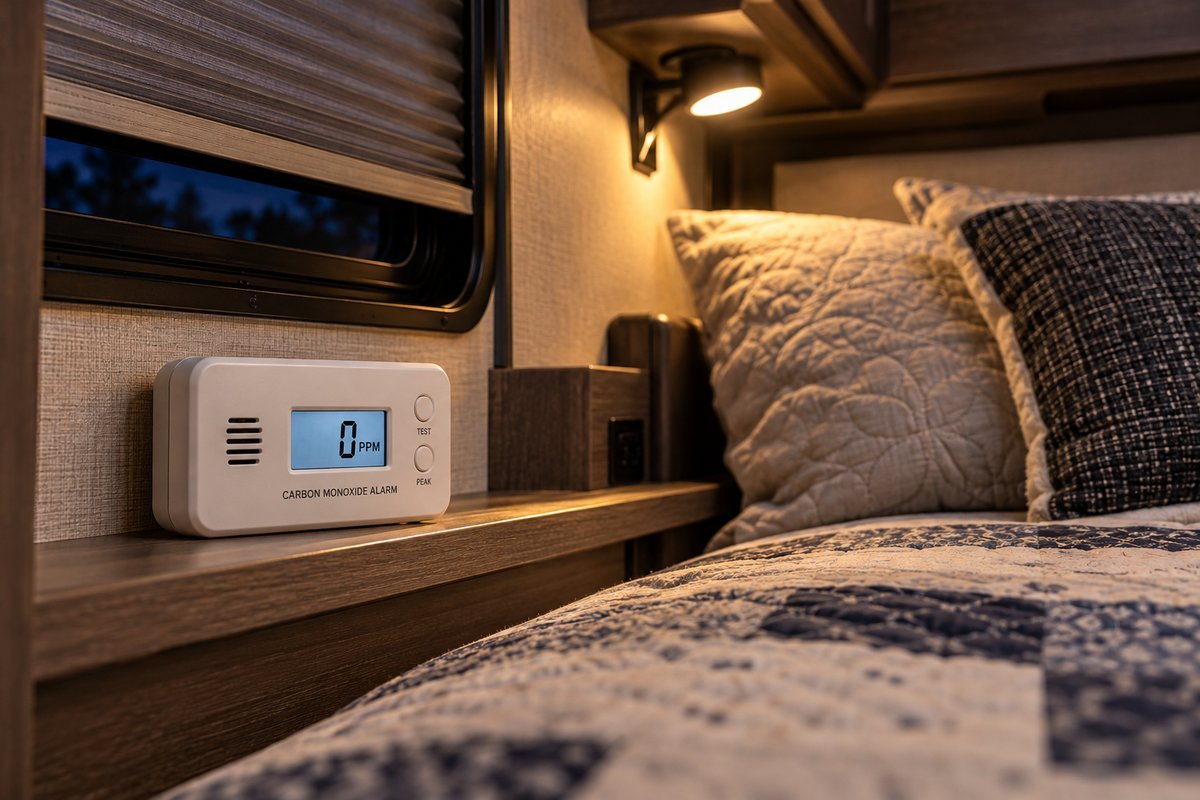
A CO alarm with a digital display helps here. It shows the CO level in the room even when it is too low to set off the alarm, and many keep a peak reading. If the display or peak reading shows any CO on a quiet night, find the source.
Where to Mount an RV CO Detector
First, follow the manual for your exact model. These rules come from the Safe-T-Alert 35 Series manual and the RV Safe propane-only alarm manual, which cover the most common RV alarms.
The Main LP/CO Alarm
- Low on the wall. Mount a combined LP/CO alarm 4 to 20 inches above the floor. The RV Safe propane alarm calls for 4 to 18 inches. Propane sinks, so the alarm must be low to detect it.
- In the kitchen area. Place it near the stove, oven, fridge, and furnace, the most likely leak points.
- Not too close to the stove. The RV Safe manual says to keep it at least 24 inches from any cooking appliance.
- Away from drafts. Keep it at least 12 inches from windows that open, outside doors, and heating or return vents. Moving air can keep gas from reaching the sensor.
- Not hidden. Do not mount it behind furniture or curtains, inside a closet, or on an outside wall.
A Second CO Alarm Near the Bed
The Safe-T-Alert CO manual repeats the Consumer Product Safety Commission advice to have a CO alarm outside sleeping areas, and recommends one in each sleeping area for the best protection. In most RVs, the kitchen alarm is far from the bed, often behind a closed door. A second CO alarm in or next to the bedroom helps make sure the alarm wakes you. A battery CO alarm is the easiest way to add one, because it needs no wiring.
If your RV has a bunk room or a second sleeping area at the other end, that space can use its own alarm too.
How to Test an RV Carbon Monoxide Detector
The Safe-T-Alert manual says to test the alarm once a week while you are using the RV, before each trip, and after storage. The CPSC recommends testing home CO alarms monthly. Weekly is easy to remember if you do it on the same day each week.
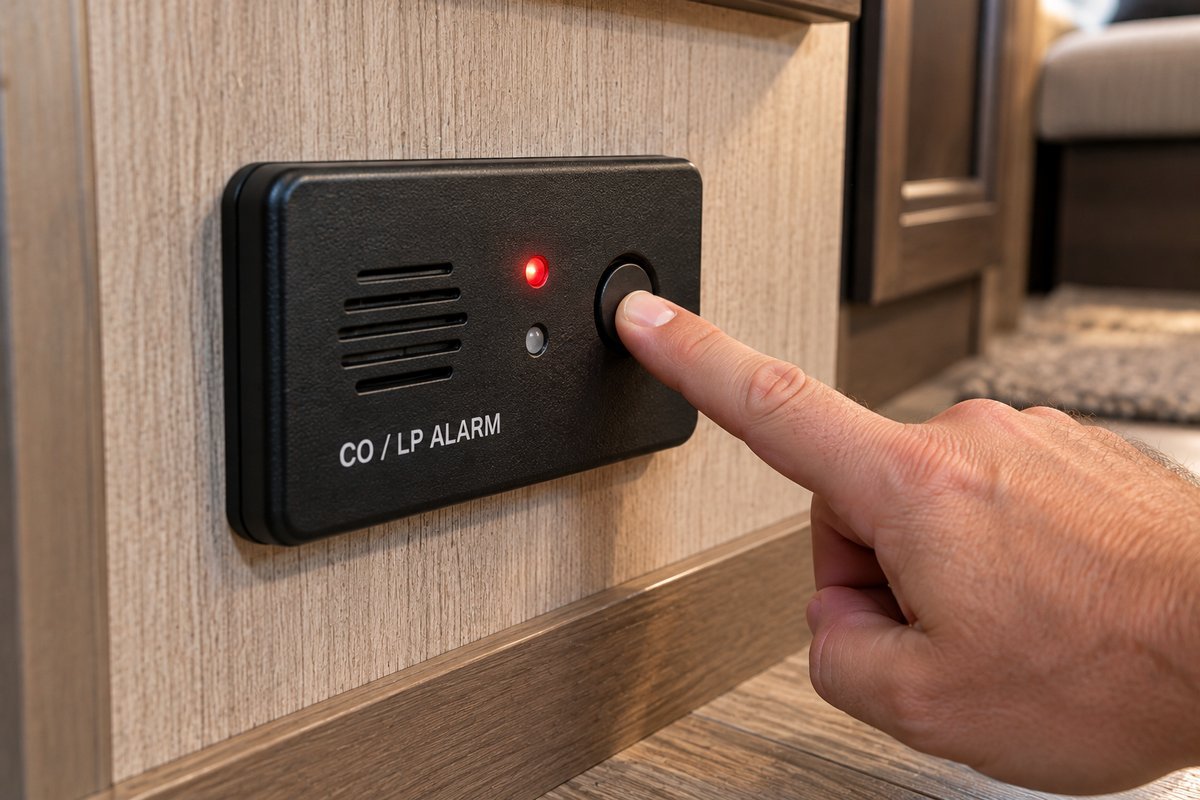
- Press and hold the test button for about 1 second.
- Watch for the light to change and listen for the horn. On a Safe-T-Alert 35 Series, the green light turns red, and the horn beeps 4 times.
- Give it up to 10 seconds to respond before deciding it failed.
- If nothing happens, check that the RV battery is charged and the alarm circuit fuse is good. If it still does not respond, replace the alarm.
Two things to know about the test:
- The button tests the electronics, not the sensor. The Safe-T-Alert manuals say this plainly. A passing test means the horn and circuit work. It does not prove the sensor can still smell gas, which is why the replacement date matters.
- It needs time to warm up. After you turn the power back on, the Safe-T-Alert 35 Series needs about 1 minute for the propane sensor to work and about 10 minutes for the CO sensor to work. Test it after that, not as soon as you reconnect the battery.
Keep the alarm clean. The RV Safe manual recommends vacuuming the front with a soft brush once a month. Do not spray cleaners, wax or hair spray near it. The RV Safe manual lists cleaning sprays, hair spray, and silicone glue among the things that can harm the sensor or set it off, and the Safe-T-Alert manual warns against spraying cleaners or wax on the front.
What to Do When Your RV CO Alarm Goes Off
Treat every alarm as real until you know it is not. These steps are based on the alarm makers' manuals, with getting outside put first.
If It Is a CO Alarm
- Get everyone out of the RV into fresh air right away. Count heads.
- Call 911 or the local fire department.
- Do not go back inside until emergency responders say it is safe and the alarm has returned to normal.
- Press the test or mute button to quiet the horn only after everyone is out.
- If the alarm goes off again within 24 hours, get everyone out and call 911 again. Then have a qualified RV or appliance technician check the furnace, water heater, fridge, and generator before you use them again.
If It Is a Propane Alarm
- Put out any open flames and do not light anything, including cigarettes.
- Do not touch light switches or other electrical switches, and do not start the engine or generator. A spark can ignite propane.
- Get everyone out and leave the door open.
- Close the main valve on the propane tank or tanks.
- Call an RV technician or your propane supplier. If you cannot reach one, call the fire department.
- Do not turn the propane back on until the leak is found and fixed.
Check your alarm's manual for its sound patterns. On RV Safe LP/CO models, a CO alarm is 4 fast chirps and a 4-second pause, and a propane alarm is a steady beep. The Safe-T-Alert 35 Series uses 4 beeps and a 5-second pause for CO and a steady tone for propane. The lights also differ by gas. Learn yours before you need it.
Why Your RV Detector Keeps Beeping
A beeping LP/CO alarm is not always a gas alarm. The manuals describe three other signals, and each one means something different.
| What you hear and see | What it usually means | What to do |
|---|---|---|
| Loud repeating alarm (4 beeps and a pause for CO, or steady for propane) | Gas detected | Follow the steps above. Get out first. |
| A chirp about once a minute with the lights flashing | Low battery voltage (below 8 volts on RV Safe alarms) | Charge the RV battery or plug in to shore power. |
| A beep every 25 to 30 seconds, with the light flashing red, red, green, green | End of life (Safe-T-Alert) | Replace the alarm. The mute only silences it for 72 hours at a time, for up to 30 days. |
| Alarm goes off after cleaning or spraying something nearby | Chemicals reached the sensor | Get everyone outside first and air out the RV. If it alarms again, treat it as a real gas leak. |
Low voltage is the most common reason an RV alarm chirps for no clear reason, especially in storage. The Safe-T-Alert 35 Series works down to 7 volts. The RV Safe alarm enters a low-battery state below 8 volts. Either way, the chirp means the house battery is nearly flat. Our guide to testing an RV battery shows how to check it.
Do not pull the fuse or cut the wires to stop a nuisance alarm. Both manuals warn against disconnecting the alarm until a replacement is ready to install. If your alarm alarms often and you cannot find the cause, replace it.
When to Replace an RV Carbon Monoxide Detector
Sensors wear out. The Safe-T-Alert 35 Series manual says you must replace the alarm within 5 years of its production date because it may not detect CO or propane accurately after that. The RV Safe manual also says to replace it 5 years after installation. The CDC says to replace CO detectors according to the manufacturer's instructions or every 5 years.
Here is how to find your alarm's age:
- Look on the back or side of the alarm for a production date or a "replace by" date.
- If you cannot remove it, check your RV's build date. A factory alarm is usually about as old as the RV.
- If the RV is more than 5 years old and you have no record of replacing the alarm, plan to replace it.
- When you put in a new one, write the install date on it with a marker.
Battery CO alarms for homes often last longer. Some have a sealed 10-year battery and are rated to last 10 years. Go by the date on your model.
How to Replace a 12-Volt RV LP/CO Alarm
Replacing a factory alarm with the same type is a common owner job, because it runs on the RV's 12-volt system, not 120 volts. Read the new alarm's instructions before you start. If the wiring does not match what is described here, have an RV technician do it.
- Write down the old alarm's model number, and note whether it is flush mount (set into the wall) or surface mount (sits on the wall).
- Buy the same model or a replacement the manufacturer says fits the same cutout. Some newer models come with a trim ring to cover the old screw holes.
- Pull the alarm circuit fuse or disconnect the negative battery cable. Make sure the alarm lights are off before you touch any wires.
- Remove the screws and pull out the old alarm. Note which wire went to positive and which to ground, and take a photo.
- Connect the new alarm the same way, using the connectors the instructions call for.
- Mount it in the same spot, as long as that spot meets the 4 to 20 inch height and the other rules above.
- Turn the power back on. Wait for the warm-up time in the manual, then press the test button.
- Write the install date on the alarm.
The Safe-T-Alert manual says the alarm must not be on a switch-controlled or ground-fault-protected circuit. On many RVs, it also turns off when the main battery switch is off, so if you sleep in the RV, keep that switch on and the battery charged. This alarm protects you from a gas you cannot see, so if you are unsure about any part of the wiring, pay a technician.
Does an RV Carbon Monoxide Detector Drain the Battery?
Yes, a little, all day and all night. The Safe-T-Alert 35 Series draws about 108 milliamps at 12 volts. That works out to roughly 2.6 amp hours a day, or about 18 amp hours a week. On its own, that will not kill a healthy battery in a weekend, but over weeks in storage it adds up along with the other small loads in the RV.
Depending on how your RV is wired, the alarm may stay on even when the battery disconnect is off. When the battery drops low enough, the alarm starts to chirp. A battery maintainer for storage keeps the battery charged so the alarm stays quiet and the battery stays healthy.
Habits That Keep CO Out of Your RV
An alarm warns you after CO is already inside. These habits help keep it out in the first place.
- Keep the generator away from the RV. The CPSC says to run a portable generator outdoors at least 20 feet from the living space, with the exhaust pointed away from doors and windows. It reports that portable generators cause nearly 100 CO deaths a year in the United States on average.
- Watch your neighbor's generator. If a nearby generator's exhaust blows toward your RV, close the windows on that side and ask them to turn it.
- Never heat the RV with the stove or oven. The Escapees RV Club lists this among its main CO warnings.
- Keep appliance vents clear. Snow, skirting, a cover, or a wasp nest can block a furnace or water heater vent. If you use skirting in winter, our guide to RV skirting covers how to keep the vents open.
- Get the furnace and water heater serviced. A yearly check by an RV technician catches cracked burners and blocked flues. These are combustion appliances, so leave repairs to a professional.
- Run the range hood fan when you cook. It pulls cooking fumes, including some CO, out of the RV.
What to Buy
RV-rated LP/CO alarms are a small category, and most of what Amazon shows is either Safe-T-Alert or unbranded copies. These are the ones worth your money.
The Ones That Do the Work
- Safe-T-Alert 35 Series Dual LP/CO Alarm, flush mount (35-742): a 12-volt combined propane and CO alarm made for RVs. It is a common factory alarm in RVs (Forest River, for example, includes its manual with its RV component manuals), so it often fits the old hole without cutting. According to the listing, it draws 108 milliamps and has a low-voltage warning. This listing is the brown version, and the model also comes in black and white.
- Safe-T-Alert 85 Series Dual LP/CO Alarm, white (85-741-WT): a newer, slimmer 12-volt LP/CO alarm from the same maker. It includes a trim ring to cover old mounting holes, which helps if your old alarm was a different size. It had far fewer ratings (72) when we checked.
Worth Having
- First Alert CO710 10-Year Battery CO Alarm with Digital Display: a battery CO alarm for the bedroom. The 10-year sealed battery means no wiring and no battery changes. The display shows the CO level and the peak reading, so you can see low levels that will not set off an alarm. It is made for homes, not listed for RV use, so treat it as a second alarm and never as a replacement for the 12-volt LP/CO alarm.
Skip
- Unbranded "2-in-1" RV gas detectors. Several listings have misspelled names, very few ratings and no clear safety listing. For a life safety device, buy a known brand with a manual you can read.
- A CO-only alarm as a replacement for an LP/CO alarm. If you swap a combined alarm for a CO-only model, you lose the propane sensor. Replace like with like.
- Plug-in home CO alarms as your only alarm. They need a 120-volt outlet, which in an RV only has power on shore power, the generator, or an inverter. Without a battery backup, they go dead when you are boondocking.
If your RV came with a battery-powered First Alert CO250RVA alarm, the exact replacement is the same model. When we checked, it was only available from third-party sellers on Amazon at a high price, so compare prices at an RV parts store before buying.
RV Carbon Monoxide Detector FAQ
Where should you place a carbon monoxide detector in an RV?
Mount the main combined propane and CO alarm 4 to 20 inches above the floor in the kitchen area, at least 12 inches from doors, windows, and vents. Add a second CO alarm near the bed so it can wake you at night.
How long do RV carbon monoxide detectors last?
Most RV LP/CO alarms last about 5 years. Safe-T-Alert counts the 5 years from the date the alarm was made, and RV Safe counts them from the day it was installed. Check the date on the back of the alarm. Some home battery CO alarms are rated for 10 years.
Why does my RV carbon monoxide detector keep going off?
A loud repeating alarm can mean real gas, so get everyone outside first. Once you are safe, the most common causes of repeat alarms are low RV battery voltage, an alarm that has reached the end of its life, and cleaning sprays or hairspray near the sensor.
Can I use a regular home CO detector in my RV?
A battery CO alarm made for homes works well as a second alarm near the bed. It should not replace the 12-volt LP/CO alarm, because a home CO alarm does not detect propane and is not listed for RV use.
Do I need a propane detector and a CO detector in my RV?
Yes. A propane leak and carbon monoxide are different dangers, and each needs its own sensor. Most RVs use a combined LP/CO alarm with both sensors in one unit.
Does an RV CO detector work when the RV is unplugged?
Yes. A 12-volt LP/CO alarm runs on the RV house battery, so it works without shore power as long as the battery is charged. When the battery runs low, it chirps.
Sources
- CDC: Carbon Monoxide Poisoning Basics
- U.S. Consumer Product Safety Commission: carbon monoxide and generator safety tips (2024)
- BRK Electronics (First Alert): What levels of CO cause an alarm?
- MTI Safe-T-Alert LP/CO Alarm Models 35-741 and 35-742 User's Manual
- MTI Safe-T-Alert RV Carbon Monoxide Alarm (62 Series) User's Manual
- RV Safe LP Alarm Models RVLP-2 and RVLP-3 Owner's Manual
- Escapees RV Club: Carbon Monoxide, an Odorless, Tasteless, and Toxic Danger