
The best GMRS radio for RV travel is usually two radios. A mobile radio in the tow vehicle or motorhome handles long-distance communication between rigs on the road, and a pair of handhelds covers everything on foot, from the campground loop to backing the trailer into a site with someone waving you in.
Restful RV is a participant in the Amazon Services LLC Associates Program, an affiliate advertising program designed to provide a means for sites to earn advertising fees by advertising and linking to Amazon.com.
GMRS is the General Mobile Radio Service, the higher-powered cousin of the license-free walkie-talkies sold at every big box store. It needs an FCC license, but one license costs $35, lasts ten years, and covers most of your family. The picks below are all certified for GMRS, which matters more than it sounds because many radios sold for it aren't.
Quick answer
For most RV owners, put a Midland MXT575 in the truck or motorhome and carry a pair of 5 watt handhelds such as the Rocky Talkie Expedition. Get the $35 FCC license first. It lasts ten years and covers your spouse, kids, parents and other close relatives, but not friends traveling with you.
Table of Contents
The 6 Best GMRS Radios for RV Travel
Two of these are mobile radios that mount in a vehicle. Four are handhelds. All six are sold as GMRS radios with FCC certification, and none of them is a ham (amateur) radio relabeled for GMRS.
Midland MXT575 MicroMobile
Best for a tow vehicle or motorhomeThis is the radio that lives in the truck. It puts out up to 50 watts, which is ten times what a handheld puts out, and it comes with a magnet mount and antenna, so you can have it working the afternoon it arrives. It has the 15 standard GMRS channels plus 8 repeater channels, and the spare USB-C port on the radio will keep a phone charged on a long day of towing.
Read the antenna section of the manual before you put the magnet mount on the roof. Midland wants the antenna on metal, and it does not work properly on fiberglass. That rules out the fiberglass cap on a lot of motorhomes, and it matters on a truck with a fiberglass topper too.
What You'll Love
- Most transmit power on this list
- Antenna and magnet mount in the box
- Built-in USB-C port for a phone
Worth Considering
- Antenna needs a metal surface, not fiberglass
- Hardwired to the battery, so plan the install
- No water rating published
Midland MXT275 MicroMobile
Simplest truck radio to installThe MXT275 is the easy way to put a radio in the tow vehicle. It plugs into a 12 volt socket with the cord in the box, and the controls are built into the microphone, so the small radio body can tuck under a seat. It runs at 15 watts high or 5 watts low and handles the same 8 repeater channels as the bigger Midland.
Fifteen watts is plenty for a caravan that stays within a few miles of itself. It is less than a third of the MXT575, so if you travel hill country or want to reach a repeater from a long way off, the bigger radio is the better buy.
What You'll Love
- Plugs into a 12 volt socket, no wiring
- Controls in the microphone, body hides away
- Comes with a magnet mount antenna
Worth Considering
- About a third of the power of the MXT575
- No water rating published
Rocky Talkie Expedition Radio (2 pack)
Best handheld for campgrounds and side tripsThis is Rocky Talkie's GMRS radio. Their better known Mountain Radio is an FRS radio, a different thing, so check the name before you buy. The Expedition is a 5 watt handheld with an IP67 rating, which means it can be submerged in a meter of water and keep working, and a battery you can swap out and charge over USB-C.
Rocky Talkie gives an honest range figure on its own listing. It says the maximum is over 35 miles but that 2 to 8 miles is typical in backcountry terrain, which is the number to plan around. The 8 repeater channels are hidden when the radio arrives. The manual shows how to switch them on.
What You'll Love
- Waterproof to 1 meter
- Replaceable battery, USB-C charging
- Comes with a short and a long antenna
Worth Considering
- Repeater channels off until you enable them
- Stops transmitting below 10 percent battery
Midland GXT67 Pro
Best handheld to pair with a Midland truck radioThe GXT67 Pro is a 5 watt Midland handheld with an IP67 rating and repeater channels, and Midland pitches it as the walk-around partner for its MicroMobile truck radios. A 12 volt vehicle charger comes in the box, which is the right accessory for someone who lives out of a truck and a trailer.
Two things to know before you buy. It is sold as one radio, not a pair. And the battery is sealed inside, so when it wears out after a few years you cannot drop in a new one.
What You'll Love
- Waterproof rating
- Vehicle charger included
- Simple to set up out of the box
Worth Considering
- Sold singly, so two cost twice
- Sealed battery you cannot replace
BTECH GMRS-V2
Best budget repeater-ready handheldThe GMRS-V2 is a 5 watt handheld with 200 channel memories and repeater channels loaded at the factory. You still enter each repeater's access tone yourself, which takes a few minutes with the manual. The antenna screws off, so you can fit a longer one later, and it charges from USB-C.
It is rated IP54. That handles rain on the campsite, and BTECH says plainly that it is not waterproof or submersible, so keep it out of the lake.
What You'll Love
- Repeater channels preloaded
- Removable antenna can be upgraded
- USB-C charging
Worth Considering
- Not waterproof
- More setup than the Midland and Rocky Talkie radios
Midland GXT1000VP4 (2 pack)
Best pair for backing into a campsiteThis is the familiar Midland pair, and it earns a place here for one reason: two headsets come in the box and the radios have hands-free voice activation. That is exactly the setup for backing a trailer into a tight site, with the spotter talking and the driver keeping both hands on the wheel. If the rechargeable packs run down, the radios also take AA batteries.
Do not buy it for distance. Midland does not list its transmit power on the product page, it cannot use repeaters, and Midland's own support notes put typical range at about half a mile to 2 miles in normal conditions. For the length of a campground loop that is fine.
What You'll Love
- Headsets and hands-free voice activation included
- Also runs on AA batteries
- NOAA weather alerts
Worth Considering
- No repeater channels
- Short range compared with the 5 watt handhelds
GMRS radios compared
| Radio | Type | Power | Repeater | Water rating | Best for |
|---|---|---|---|---|---|
| Midland MXT575 | Mobile | Up to 50 W | Yes | Not published | Tow vehicle or motorhome |
| Midland MXT275 | Mobile | 15 W | Yes | Not published | Easy plug-in install |
| Rocky Talkie Expedition | Handheld | 5 W | Yes, unlock first | IP67 | Campgrounds and hikes |
| Midland GXT67 Pro | Handheld | 5 W | Yes | IP67 | Pairing with a Midland mobile |
| BTECH GMRS-V2 | Handheld | 5 W | Yes, add tones | IP54 | Budget repeater use |
| Midland GXT1000VP4 | Handheld pair | Not listed | No | Splash only | Backing into a site |
Handheld or Mobile: Which GMRS Radio Does an RV Need?
A handheld is a walkie-talkie. It goes in a pocket, runs on a battery, and works anywhere you walk. A mobile radio is a box that mounts in the vehicle, runs off the 12-volt system, and uses a roof antenna. The FCC lets mobile stations on the main GMRS channels run up to 50 watts of transmitter output, according to 47 CFR 95.1767, and the handhelds on this list top out at 5.
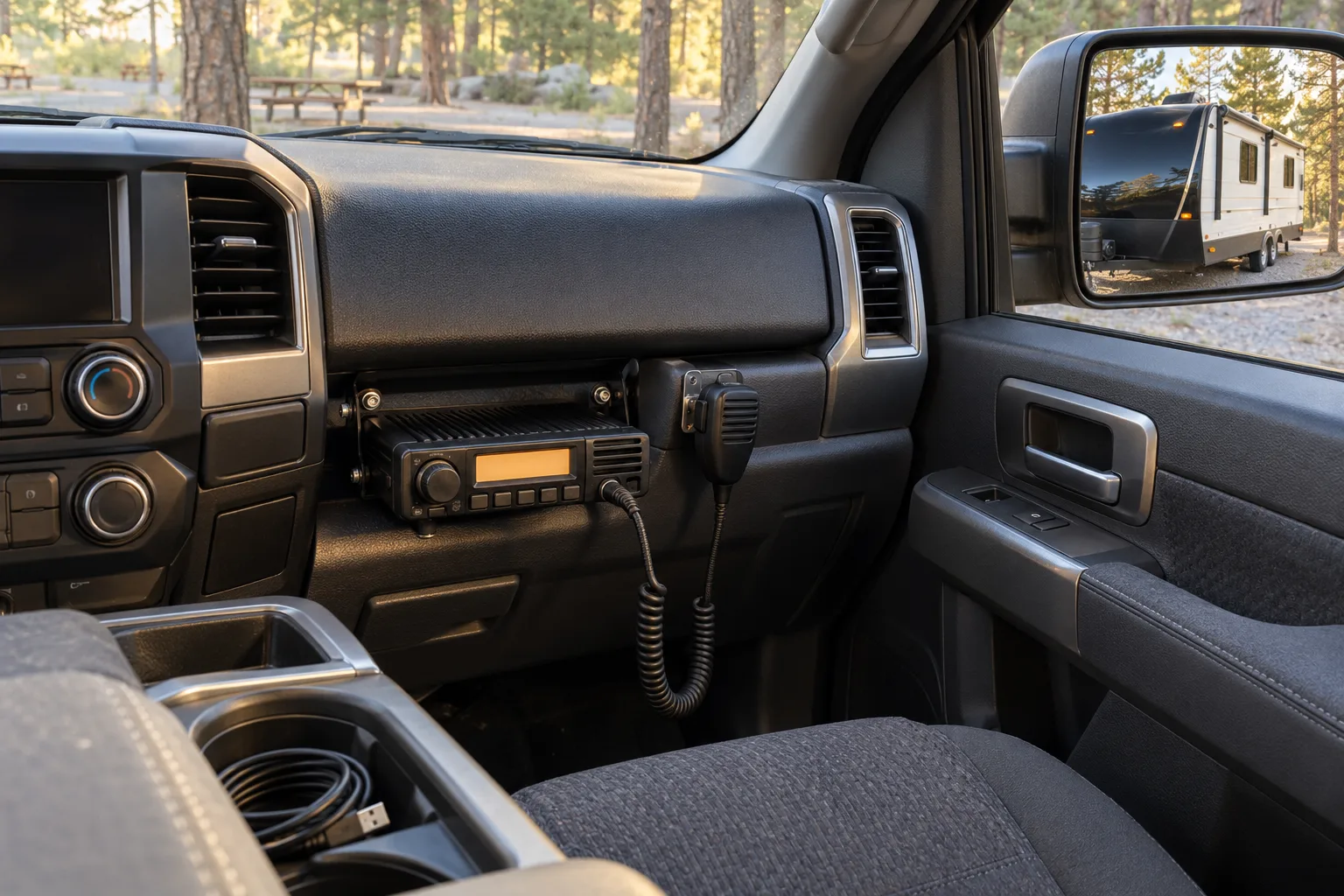
That gap is why the two kinds of radio do different jobs. Watts help, but the bigger difference is the antenna. A handheld's short antenna sits at chest height inside a metal-filled cab. A mobile radio's antenna sits on the roof, a few feet higher and out in the open, and on GMRS, antenna height does more for range than extra watts.
So the split for an RV is simple. If you tow or drive a motorhome with someone following in a car, put a mobile radio in each moving vehicle. If you use your radio mostly around the campsite, handhelds alone are fine. The best GMRS radio for a highway convoy is rarely the same as the best one for a campground loop, which is why most groups end up with both.
How Far Will a GMRS Radio Reach?
Not as far as the box says. The FCC's own GMRS page puts the expected range at one to twenty-five miles, depending on the kind of station, the terrain, and whether a repeater is involved. The manufacturers' big numbers are line-of-sight figures, like one mountaintop talking to another. Rocky Talkie says its Expedition radio typically reaches 2 to 8 miles in backcountry terrain, and Midland's support notes put its GXT handhelds at about half a mile to 2 miles in normal conditions.
On the road, plan for the worst case. Two handhelds in two cabs on a tree-lined highway will lose each other quickly once a hill gets between them. Two mobile radios with roof antennas will hold on far longer, which is the whole argument for putting one in each vehicle of a caravan.
A repeater changes that. A radio on a tower or hilltop picks up your signal and rebroadcasts it, stretching a conversation across a whole valley. Every radio on this list except the Midland GXT1000VP4 can use one.
Do You Need a License for a GMRS Radio?
Yes. A valid individual license is required to operate a GMRS station, as stated in 47 CFR 95.1705. The FCC fee schedule lists the GMRS license at $35, and the license term is ten years. You have to be at least 18 to apply. You apply online through the FCC, and the requirements list no test.
One license covers your immediate family, and the FCC spells out exactly who that is: spouse, children, grandchildren, stepchildren, parents, grandparents, stepparents, brothers, sisters, aunts, uncles, nieces, nephews, and in-laws. Age doesn't matter for the family member doing the talking, so the grandkids can use the radios at the campground under your license.
It does not cover friends. If two couples travel together in separate rigs, each household needs its own license. At $35 for ten years, that is the cheapest piece of the whole setup.
Do you have to say your call sign on GMRS?
Yes. Under 47 CFR 95.1751, you identify with your FCC call sign at the end of a transmission or a series of transmissions, and every 15 minutes during a long conversation. You can say it in plain English, and you can add a unit number after it, so a family might use the call sign followed by "unit 2" for the second radio.
Can GMRS Radios Talk to FRS Walkie Talkies?
They can. FRS, the Family Radio Service, covers the license-free walkie-talkies sold in most stores, and the FCC's FRS page confirms that no individual license is needed to use one. GMRS and FRS share most channels, and GMRS rules allow GMRS stations to talk with FRS units. So a GMRS family can still reach the neighbors at the campground who brought a pair of store-bought FRS radios.
The difference is power and options. FRS radios are capped at 2 watts on most channels, and since 2019 no new radio can be sold that works as both an FRS and a GMRS radio, under 47 CFR 95.1791. Rocky Talkie's popular Mountain Radio is an FRS radio, which is fine for hiking but is not the same product as its GMRS Expedition.
How to Use GMRS Radios When Backing Into a Campsite
This is where a pair of radios pays for itself on the first trip. Backing a travel trailer into a tight site with a spotter usually means shouting through a closed window or reading hand signals in a side mirror that shows half the person. A radio turns it into a conversation.
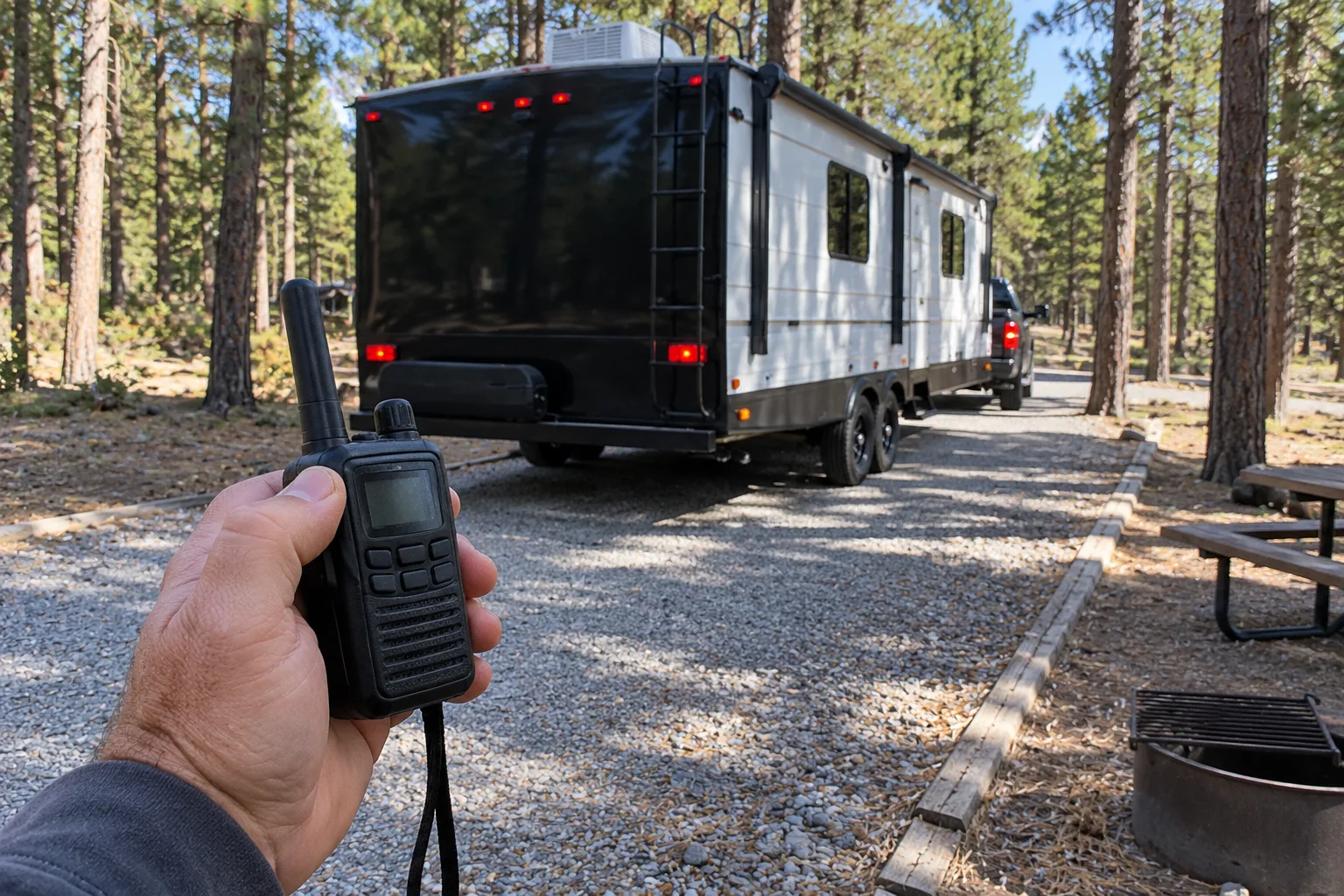
Pick a channel before you pull into the campground and set both radios to it. Listen for a minute first, since other campers may already be using the obvious channels. A headset with hands-free voice activation, like the pair that comes with the Midland GXT1000VP4, lets the driver keep both hands on the wheel and hear the spotter clearly with the windows up.
Agree on a short set of words before you start. "Stop" means stop, every time, said once and loud. Have the spotter stand where the driver can see them in a mirror as well, because a radio that cuts out mid-sentence should never be the only thing between the trailer and a tree. If you also run a backup camera on the trailer, the radio fills in what the camera cannot see, like the picnic table sitting low behind the bumper.
Setting Up Radios for an RV Caravan
A group of rigs traveling together needs a plan more than it needs more watts. Choose one channel for the group and a second one as a backup, and write both on a card in every cab. Agree that the lead rig calls out turns and fuel stops early, since the last rig in a long caravan may be a mile behind when the turn comes.
Privacy codes help on a busy channel, but they do not make a conversation private. A privacy code only stops your radio from playing other groups on the same channel. Anyone on that channel without your code can still hear you, so leave the gate codes and campsite numbers for a phone call.
The GMRS rules also make room for road trips. 47 CFR 95.1731 allows you to use any GMRS channel for emergency messages and traveler assistance, and to send one-way warnings about hazardous road conditions. A lead rig calling back to say there's a stalled truck around the next bend is exactly what the service is for.
Can you use someone else's GMRS repeater?
Only with permission. The rules let a repeater owner open it to anyone, limit it to specific people, or turn specific people away, according to 47 CFR 95.1705. Many owners list their repeaters in public directories, along with how to request access, so it is worth checking the route before a trip through mountain country and setting up the tones on your radios at home rather than at a rest stop.
Mounting a Mobile Radio in a Tow Vehicle or Motorhome
The antenna matters more than the radio. Midland's MXT575 user guide says to mount the antenna on metal, not fiberglass, because the metal roof underneath is part of how it works. On a pickup, that usually means the cab roof. On a motorhome with a fiberglass roof cap, that means finding a metal surface or using an antenna designed to work without one, and it is worth asking an installer before you drill.
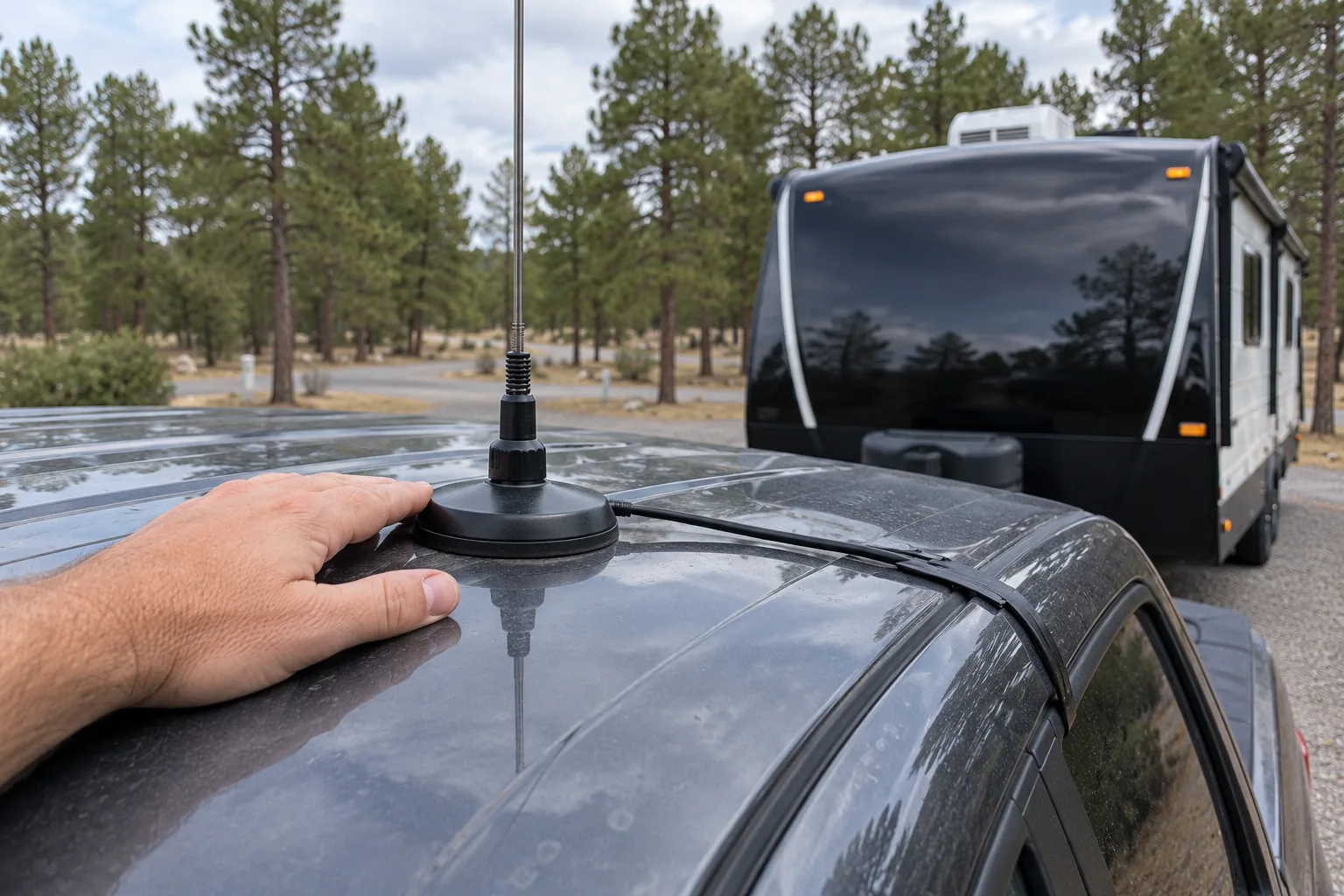
Keep people away from the antenna while you transmit. The same guide says to keep about 16 inches away, so a magnet mount in the middle of the roof is better than one on a fender beside the passenger window. The microphone cord should reach the driver comfortably without crossing the airbag panel.
Power is the other half. The Midland MXT275 plugs into a 12-volt socket, which is the simplest install. The 50-watt radios draw more current and connect to the vehicle's 12-volt system through a fuse, which is straightforward 12-volt work. Follow the manual for the fuse and wire size rather than guessing, and if you would rather not run wire through the firewall, a car audio or two-way radio shop can do it for you.
Which GMRS Radios Should You Skip?
Skip any ham radio sold as a GMRS radio. The FCC will not certify a radio for GMRS if it can also operate in the amateur bands, under 47 CFR 95.1761. Popular amateur handhelds such as the Baofeng UV-5R are not GMRS radios, however often they show up in GMRS lists, and transmitting on GMRS with one is not legal. Look for the word GMRS in the model name and check that the maker says it is certified for the service.
Be wary of handhelds that advertise more than 5 watts. A higher number on the box doesn't buy much range when the antenna is the limit, and it can signal the radio wasn't built with GMRS rules in mind. Every handheld on our list sticks to 5 watts or less.
And skip the mileage numbers on the packaging. They describe ideal conditions that an RV on a highway will rarely see. Read the maker's typical range instead, if they publish one, and buy a mobile radio if distance between rigs is what you need.
Quick Answers
What is the best GMRS radio for an RV?
For most RV owners, the answer is two kinds of radio. Put a mobile radio, such as the Midland MXT575, in the tow vehicle or motorhome for talking between rigs on the road, and carry a pair of 5-watt handhelds, such as the Rocky Talkie Expedition, for the campground.
Which GMRS radio has the longest range?
A mobile radio with a roof antenna will reach farther than any handheld. The Midland MXT575 has the most power on our list, up to 50 watts. The FCC lists typical GMRS range as 1 to 25 miles, depending on the station, terrain, and whether you use a repeater.
Can you use a GMRS radio without a license?
No. You need an FCC license to transmit on GMRS. It costs $35, lasts ten years, and covers your immediate family. If you don't want a license, buy FRS walkie-talkies, which don't require one.
How do you get a GMRS call sign?
Your call sign comes with your license. Apply through the FCC's online licensing system and pay the $35 fee, and the FCC issues the call sign you will say at the end of each conversation and every 15 minutes during a long one.
What is the best walkie talkie for RV travel?
For backing into a campsite, the Midland GXT1000VP4 pair is a good fit because it includes headsets and hands-free voice activation. For more range and repeater use, choose a 5-watt GMRS handheld such as the Rocky Talkie Expedition or the Midland GXT67 Pro.
Is a GMRS radio easy to use?
Yes. A handheld works like any walkie-talkie: pick a channel, press the button, and talk. The Midland MXT275 plugs into a 12 volt socket, so it is the easiest mobile to install. Repeaters take a few minutes to set up with the manual.
Where to Go Next
If you are setting up a rig for the road, our guide to RV backup cameras pairs well with a set of radios for backing into a site, and our RV towing guide covers the rest of the towing setup. For staying connected where cell service runs out, see our look at Starlink for RV travel.