
Most RVs come with a lightweight, plastic faucet built for the price. When it starts to drip or the handles loosen, you have more options than you might think. Many RV faucets fit the hole layouts common in RV sinks, but not every faucet fits every sink, so measure first. A household faucet can work too, as long as it fits your sink, your counter space, and your water lines.
Restful RV is a participant in the Amazon Services LLC Associates Program, an affiliate advertising program designed to provide a means for sites to earn advertising fees by advertising and linking to Amazon.com.
This guide covers four faucets worth a look, how to measure before you buy, the connection sizes that cause the most trouble, and the steps to swap one out yourself.
Quick answer
Most RV galley (kitchen) sinks have one hole, or two or three holes about 8 inches apart, center to center. Many RV faucets, like the Dura Faucet J-Spout, are made for those layouts, but measure your sink before you buy. A household faucet can work too, but check three things first: the hole setup, the space above the sink, and the connection size. RV water lines often end in 1/2 inch fittings, and many household faucets use 3/8 inch. Check your own fittings before you buy adapters.
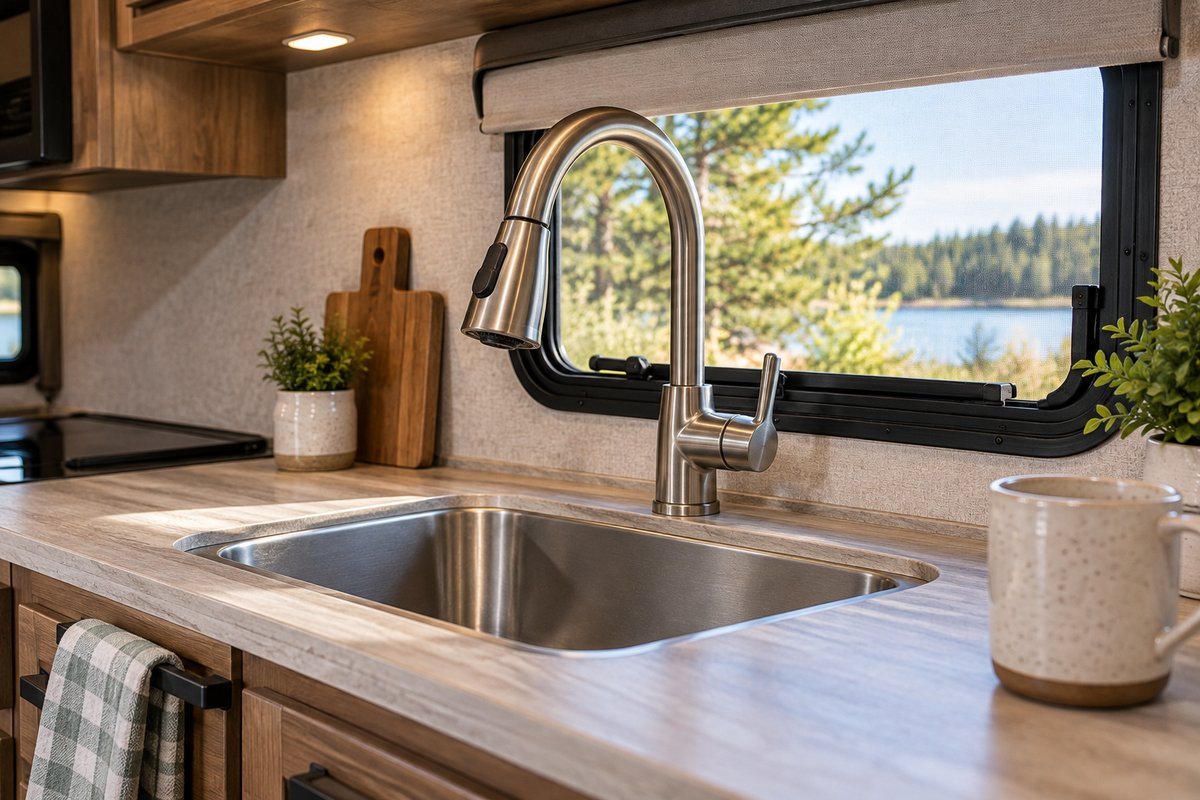
Table of Contents
4 RV Kitchen Faucets Worth a Look
These picks are based on the makers' published specs and, when a maker doesn't publish specs, on seller listings. One is made for RVs, and three are household faucets that suit RV sinks. Check the hole setup and connection size against your sink before you order.
Specifications note: Some dimensions and flow rates come from retailers and can vary by listing or model version. Confirm the specs and connections for the exact faucet before you order.
Dura Faucet J-Spout RV Kitchen Faucet
Best direct swap for an RV sinkThis is a classic RV galley faucet, with two lever handles and a tall J-shaped spout. Dura Faucet makes it for RVs, and sellers list it for sinks with 2 or 3 holes and with male 1/2 inch connections.
Dura's catalog describes a 12 inch tall brass spout with plastic water paths, which keeps it light. Sellers list it at about 12.6 inches tall overall and about 1.45 pounds, with a flow rate of 2 or 2.2 gallons per minute. Dura's warranty covers leaks and drips for as long as the original buyer owns the faucet, and plated finishes for 1 year. The model number is DF-PK330HC, and it comes in several finishes.
What You'll Love
- Made for RV galley sinks
- 1/2 inch connections match many RV lines
- Light, with plastic water paths
Worth Considering
- Plastic water paths are less durable than metal
- Tall spout can hit a window or cabinet
- No sprayer
Peerless Xander Pull-Out Kitchen Faucet
Best single-handle pull-outPeerless is a value brand from Delta Faucet. If you want one handle and a pull-out sprayer, this compact household faucet suits an RV galley. Peerless lists the spout outlet about 5 11/16 inches above the counter and a total spout height of 8 3/4 inches, so it sits lower than most pull-down faucets. The spout reaches 8 3/16 inches and turns 120 degrees.
The Peerless spec sheet lists a maximum flow of 1.5 gallons per minute at 60 psi, a ceramic cartridge, and supply hoses that end in 3/8 inch compression fittings, so you will likely need adapters for 1/2 inch RV lines. It mounts in one, two, three or four holes, but the deck plate for a 3 hole sink is sold separately. The mounting surface can be up to 1 1/2 inches thick. The lifetime limited warranty does not cover damage from freezing water. The model number is P6919LF, and the black version shown is P6919LF-BL.
What You'll Love
- Pull-out sprayer
- Lower than most pull-down faucets
- Full specs published by Peerless
Worth Considering
- Likely needs adapters
- Deck plate sold separately
- Warranty excludes freeze damage
Moen Adler Pulldown Kitchen Faucet
Best household upgradeThis is a household faucet that can replace a plastic RV faucet if your sink has room for it. It has a pull-down sprayer with a stream and a stronger rinse setting. Moen's spec sheet lists 1 or 3 hole mounting with the included deck plate, a flow rate of 1.5 gallons per minute at 60 psi, and a 68 inch braided hose.
Check two things first. Moen lists the faucet at about 14.6 inches tall overall, with the spout outlet about 8.3 inches above the counter, so you need room above the sink. Moen also lists 3/8 inch compression connections, so you will likely need adapters or new supply lines to join it to 1/2 inch RV lines.
Moen's lifetime warranty is written for homeowners, so confirm coverage for an RV install with Moen. The model number is 87233SRS.
What You'll Love
- Pull-down sprayer with two settings
- Lower 1.5 GPM flow saves tank water
- Full specs published by Moen
Worth Considering
- Tall for an RV galley
- Likely needs adapters
- Lifetime warranty may not cover an RV
Peerless P110LF Single-Handle Kitchen Faucet
Best for low clearanceThis Peerless model has a low arc spout that swivels all the way around and a single lever handle. Peerless's spec sheet lists it for 3 hole sinks with 8 inch centers. It also lists a maximum mounting thickness of 3/8 inch, so measure the thickness where your faucet mounts before you buy.
Peerless lists the spout outlet about 5 1/8 inches above the counter and the whole faucet at about 7 1/2 inches tall, so it fits where a tall faucet will not. It also lists an 8 inch spout length, a maximum flow of 1.5 gallons per minute at 60 psi, and male 1/2 inch inlets. Its lifetime limited warranty does not cover damage from freezing water, so winterize with care. It has no sprayer.
What You'll Love
- Low spout fits tight spaces
- Full specs published by Peerless
- Lower 1.5 GPM flow
Worth Considering
- No sprayer
- Mounting surface must be 3/8 inch thick or less
- Warranty excludes freeze damage
RV kitchen faucets compared
On a phone, swipe the table sideways to see every column.
| Faucet | Holes | Connection | Overall height | Flow |
|---|---|---|---|---|
| Dura Faucet J-Spout | 2 or 3 | 1/2 inch male | 12.6 inches | 2 or 2.2 GPM |
| Peerless Xander | 1, 2, 3 or 4 | 3/8 inch compression | Spout 8.75 inches (overall not published) | 1.5 GPM |
| Moen Adler | 1 or 3 (deck plate) | 3/8 inch compression | 14.6 inches | 1.5 GPM |
| Peerless P110LF | 3, 8 inch centers | 1/2 inch male | 7.5 inches | 1.5 GPM |
Can You Put a Household Faucet in an RV?
Yes. Camping World says, "practically any faucet will work in an RV," and that a household faucet is likely a better option, as long as the fittings are secure. Camping World also notes that many RV faucets are plastic and can leak over time.
A household faucet needs to pass four checks:
- It fits your holes. A single-hole faucet with a deck plate can cover a three-hole sink. Going the other way is harder.
- It fits the space. Tall faucets can hit a window, a cabinet, or a slide-out wall.
- It connects to your lines. You may need adapters, which we cover below.
- Your counter can support the weight. Metal faucets weigh more, and RV counters and sinks are often thin.
How to Measure Before You Buy
A few minutes of measuring can save you a return. Use a flashlight to look under the sink and check these.
Count the holes
Most RV kitchen faucets mount in one, two, or three holes. Lippert, a major RV parts maker, says a single-hole faucet usually comes with a base plate that covers the other two holes. If you have one hole now and want a three-hole faucet, you would have to drill more holes, so it is easier to buy a faucet that matches the holes you have.
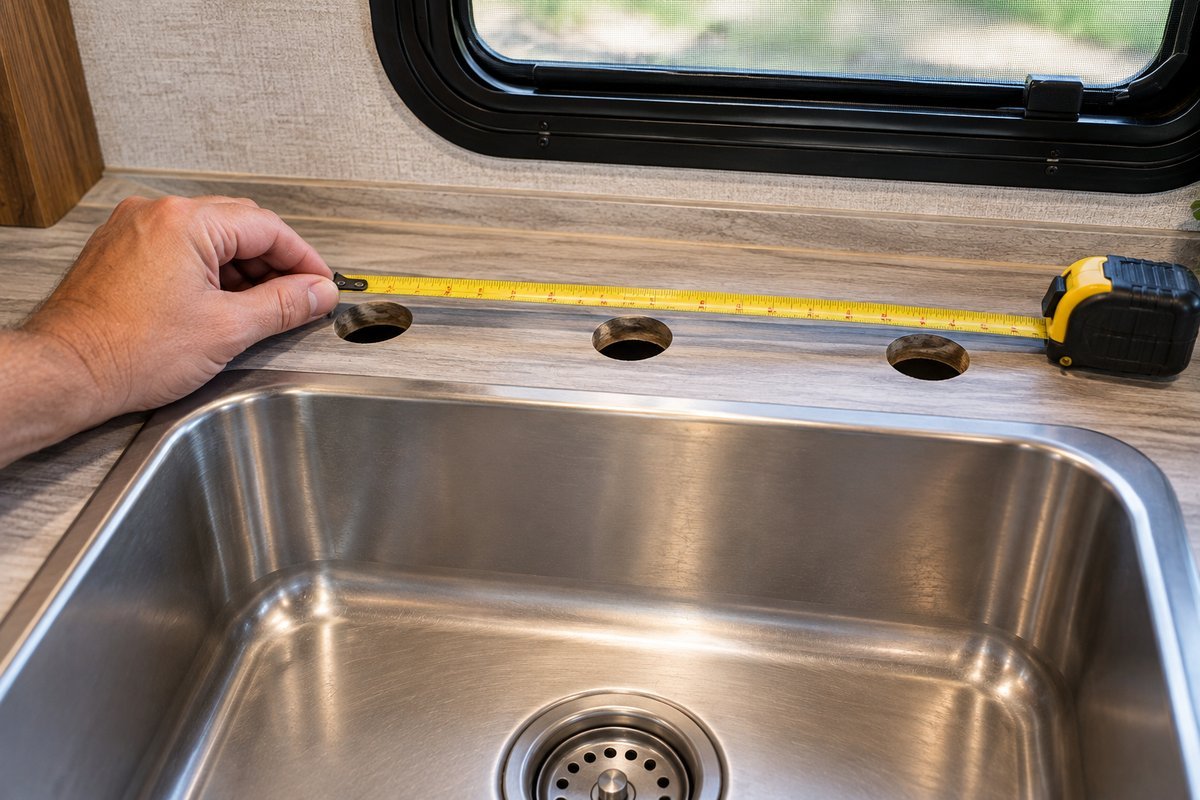
Measure the spread
For a three-hole sink, measure from the center of the left hole to the center of the right hole. RVtravel says galley sinks are usually 8 inches on center, and bathroom sinks are usually 4 inches. eTrailer adds that you can also measure the width of the old faucet's base plate to get close.
Check the height above the sink
Measure from the counter to anything above it: a window frame, an overhead cabinet, or the wall when a slide-out is closed. One owner who commented on RVtravel said height was the real limit. Plenty of faucets fit the holes, but fewer are short enough. A low-arc faucet, like the Peerless P110LF above, is a good choice for a tight spot.
Look at the space under the sink
Pull-down and pull-out faucets have a hose that hangs under the sink and slides up when you pull the sprayer. It needs room to move without catching on the water heater lines, the drain, or anything stored in the cabinet.
RV Faucet Connections: 1/2-inch or 3/8-inch?
Connection size causes the most trouble when you swap a faucet. Getaway Couple says RV supply lines commonly end in a 1/2 inch female connection. Many RV faucets are built to match. Seller listings for the Dura Faucet J-Spout, for example, say it has male 1/2 inch connections.
Many household faucets use a different size. Moen lists the Adler with a 3/8 inch compression connection. To connect the two, you need an adapter or new supply lines with the right size on each end. Getaway Couple suggests a compression adapter, such as a 3/8-inch compression-to-1/2-inch male brass union.
Measure before you buy adapters. Many fittings have the size printed on the nut or the line. If yours do not, take the old supply line or faucet to a hardware store and match it there. Then check the connection size in the new faucet's specs.
Plastic or Metal?
RV faucets are often plastic, or mostly plastic, because they are light and don't corrode. Dura Faucet's catalog says the J-Spout has a brass spout with synthetic water paths, and sellers list it at about 1.45 pounds. A metal-bodied faucet usually weighs more.
Plastic is fine for many owners. The trade-off is that plastic parts and fittings crack more easily. One RVtravel commenter warns about cheap knock-offs of big brands sold online. If you want metal, buy a known brand with a real warranty from a seller you trust.
Whatever you choose, do not overtighten plastic fittings. Your RV water pressure regulator also matters because high campground pressure stresses plastic fittings.
Flow Rate and Your Fresh Water Tank
Flow rate is how much water a faucet lets out each minute. Under federal rules, a kitchen faucet can flow no more than 2.2 gallons per minute at 60 psi, according to the Building America Solution Center at Pacific Northwest National Laboratory.
On city water, flow rate matters less. On your fresh tank, it adds up quickly. Running a faucet for 5 minutes at 2.2 gallons per minute uses 11 gallons. At 1.5 gallons per minute, it uses 7.5 gallons. If you camp without water hookups, a lower flow faucet helps your water last longer. Real use depends on your pump and how far you open the handle.
How to Replace an RV Kitchen Faucet
These steps are based on the guides from Lippert, Camping World, and Getaway Couple. Always follow the instructions that come with your new faucet.
What you need: an adjustable wrench, channel lock pliers, a basin wrench or deep socket for the mounting nuts, a flashlight, a towel, and a small bucket. Have adapters ready if the sizes do not match.
- Shut off the water and let it cool. Turn off the water heater (gas and electric, if it has both) and let the hot water cool. Disconnect the city water hose and turn off the water pump. Then open the faucet on both hot and cold and leave it open until the water stops. This releases the pressure in the lines.
- Clear the cabinet. Empty the space under the sink, then place the towel and bucket under the lines.
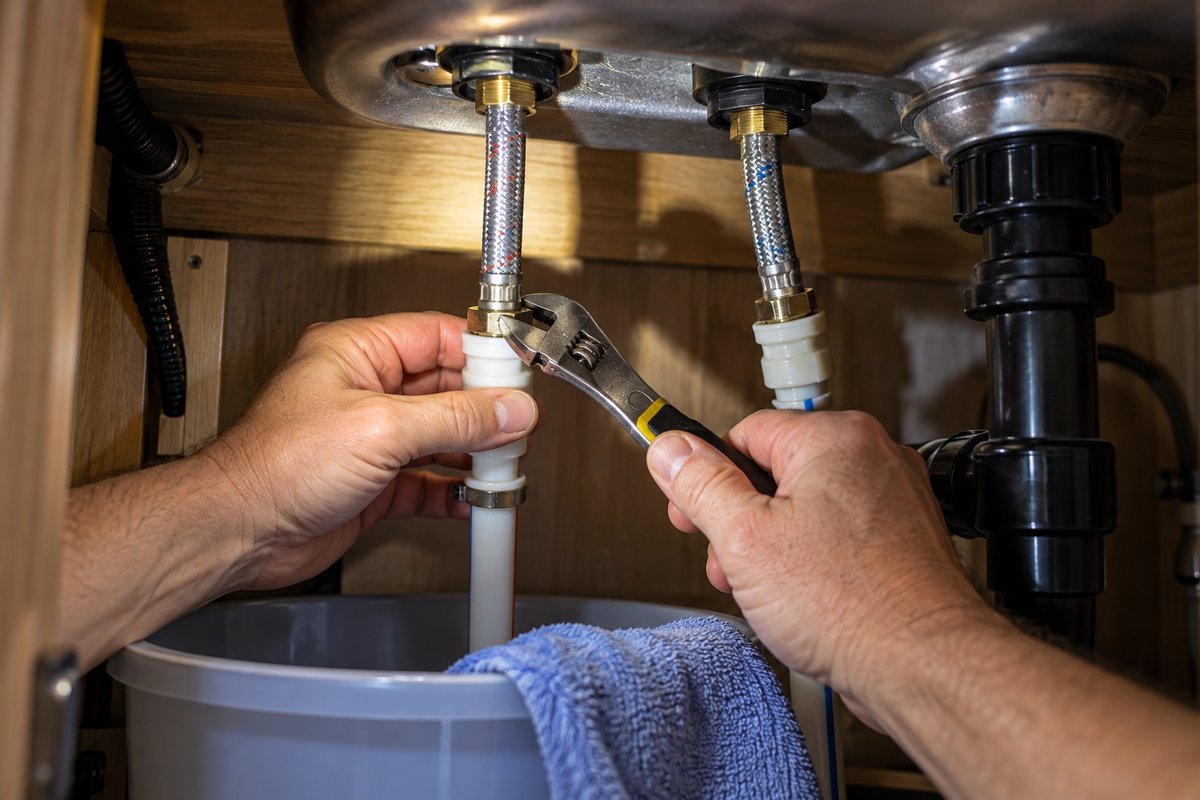
- Disconnect the supply lines. Make sure the water has stopped and the hot line is no longer warm. Then loosen the hot and cold lines from the faucet. Some water will drain out.
- Remove the old faucet. Take off the mounting nuts under the sink and lift the faucet out. Scrape off any old sealant and wipe the counter clean.
- Set the new faucet. Use the gasket, deck plate, or sealant the faucet manufacturer recommends. Camping World says sealing the base well is critical because water that gets under the faucet can damage the counter.
- Tighten the mounting nuts. A helper above the sink can hold the faucet straight while you tighten from below.
- Connect the lines. Lippert notes that the hot water supply goes on the left. Tighten the fittings until snug, but don't overtighten plastic threads.
- Check for leaks. Turn the pump on or reconnect city water. Run hot and cold water for a couple of minutes, then check every fitting with a dry paper towel. Turn the water heater back on only after water runs steadily from the hot side.
Check under the sink again the next day. A slow drip can take hours to show. For early warning next time, a water leak detector under the sink will alert you.
Don't Forget Your Faucet When You Winterize
A new faucet needs the same winter care as the old one. RV makers such as Grand Design, Keystone, and Tiffin say to open each faucet, hot side and cold side, until pink antifreeze comes out, and then close it. Airstream's guide also reminds owners not to forget the hand sprayer, so run a pull-down or pull-out sprayer too. If you blow the lines out with air instead, our guide on how to winterize an RV explains when to leave the faucets open. None of the faucet makers in this guide publish RV winterizing steps, and Peerless warranties don't cover freeze damage.
If your water tastes bad after the swap, the faucet may not be the cause. An RV water filter on the hose can help with bad campground water.
Quick Answers
Can you use a regular kitchen faucet in an RV?
Yes. Most household kitchen faucets can work in an RV if they fit your sink holes, clear the space above the sink, and connect to your water lines. Many need adapters because RV lines often end in 1/2-inch fittings, while many household faucets use 3/8-inch. Measure your fittings before you buy adapters.
What size faucet fits an RV kitchen sink?
Most RV galley (kitchen) sinks have one hole, or two or three holes about 8 inches apart, center to center. Measure from the center of the left hole to the center of the right hole to be sure, and check the height above the sink.
Are RV faucet connections 1/2 inch or 3/8 inch?
Many RV supply lines end in 1/2 inch connections, and many RV faucets are built to match. Many household faucets use 3/8 inch compression connections. Measure your own fittings and check the new faucet's specs. Get adapters only if the sizes don't match.
Why are RV faucets made of plastic?
Plastic is light and does not corrode, which suits a vehicle that has to watch its weight. The downside is that plastic parts and fittings can crack or leak over time, which is one reason owners upgrade.
How long does it take to replace an RV kitchen faucet?
Getaway Couple says most people can do this job in under 30 minutes with the right tools. Plan for longer if the space under your sink is tight or you need to find adapters.
Why is my new RV faucet leaking?
Check the supply line fittings first. They may be loose, or the sizes may not match. Then check the base, because a poorly sealed faucet can let water under the counter. Do not overtighten plastic fittings, since that can crack them.
Where to Go Next
If you are working on your RV's water system, start with an RV water pressure regulator to protect your new faucet and fittings. Upgrading the bathroom too? See our guide to the best RV shower head. Then get ready for cold weather with our guide on how to winterize an RV.