
An RV tankless water heater heats water only when a faucet is open, so you won't run out of hot water halfway through a shower. It replaces the 6 or 10-gallon tank heater most RVs come with, burns propane on demand, and needs a 12-volt connection for its controls and fan. The catch is that "endless" hot water has real limits: flow, cold incoming water, propane, and how much room your gray tank has left.
Restful RV is a participant in the Amazon Services LLC Associates Program, an affiliate advertising program designed to provide a means for sites to earn advertising fees by advertising and linking to Amazon.com.
This guide covers four RV tankless water heaters you can buy today, how much hot water they really make in cold weather, a sizing check you can run for your own shower, the minimum-flow problem with low-flow shower heads, fit and installation, winterizing, descaling, and the error codes owners run into most. It is a choosing guide. Gas line and vent work should be done by a qualified RV technician.
Quick answer
An RV tankless water heater is worth it if you shower back to back or camp for long stretches with campground water and power hookups or full propane tanks. A 60,000 BTU (British thermal units, a measure of heat) unit gives about 1.5 to 1.7 gallons per minute (GPM) of shower-temperature water when the incoming water is 40 to 50 degrees, so pair it with a shower head that flows about 1.5 GPM or less, but not so little that the burner will not light. Pick one with built-in freeze protection, plan for yearly descaling, and have a technician handle the propane and vent work.
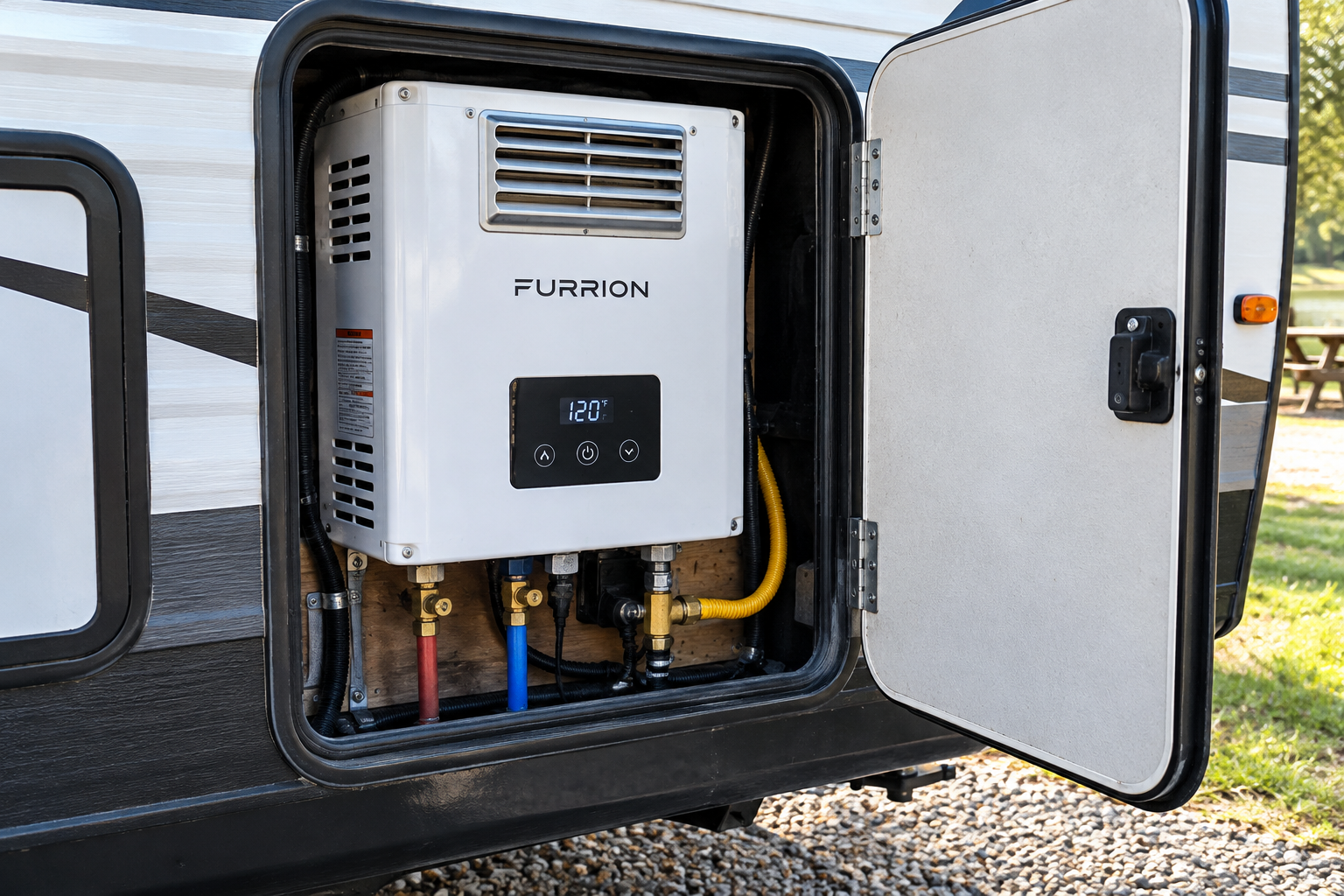
Table of Contents
4 RV Tankless Water Heaters Worth a Look
Suburban Nautilus IW60
60,000 BTU · two-stage modulating burner · freeze mode built in
Check Price on AmazonFogatti InstaShower 8 Plus
55,000 BTU · up to 2.9 GPM · fits 15x15 to 18x18 doors
Check Price on AmazonEach pick below was in stock on Amazon with an add-to-cart button when we checked. The specs come from the maker or the listing. The flow numbers are each maker's best case, which usually assumes warm incoming water, so read the sizing section before you choose.
Furrion Tankless Gas Water Heater with Antifreeze Protection (FWH09AFA-AM)
Best all-around retrofitFurrion rates this unit at 60,000 BTU and up to 2.4 gallons per minute. It is built as a retrofit, meaning it replaces the tank water heater already in your RV, and it adds an antifreeze mode, which matters if you camp in fall and spring when nights drop below freezing.
The included wall thermostat shows the water temperature, the time and the water pressure, and it flags low pressure with an error code. That last part helps, because low pressure is one of the most common reasons a tankless unit will not light. Furrion lists a pressure relief valve, over-temperature protection, a shutoff if the fan's air path gets blocked and automatic shutoff. Furrion also says its tankless heaters need 35 to 70 psi (pounds per square inch) of water pressure and are tested up to about 4,500 feet, so contact Furrion support before long stays higher than that.
What You'll Love
- Antifreeze mode for spring and fall trips
- Wall thermostat shows pressure and error codes
- Shipped and sold by Amazon when we checked
Worth Considering
- Freeze modes need propane and 12-volt power to work
- Call Furrion before long stays above about 4,500 feet
- Low stock at times, so check the listing
Suburban Nautilus IW60 On-Demand Water Heater (5286A)
Best for Suburban tank ownersSuburban's Nautilus IW60 is a 60,000 BTU on-demand heater with a burner that turns its flame up and down to match the flow, plus built-in freeze protection. Suburban built it to replace its own 6, 10, 12 and 16-gallon tank heaters, so it is the natural pick if your RV already has a Suburban unit and you want to keep the same brand. Suburban's newer Advantage tankless heater now fills the same role in its lineup.
The Amazon listing is thin on details, so match the part number (5286A) to Suburban's own documentation before you order, and have your technician confirm the opening and gas connection. The IW60RL versions add a recirculating loop and are a different part.
What You'll Love
- Made to drop into Suburban tank openings
- Modulating burner for steadier temperature
- Built-in freeze protection
Worth Considering
- Sold by a third-party RV parts seller on Amazon
- Listing has few specs, so confirm with Suburban
- Maker does not list a top flow rate in the listing
FOGATTI InstaShower 8 Plus RV Tankless Water Heater
Best for odd-size openingsFogatti lists the 8 Plus at 55,000 BTU and up to 2.9 gallons per minute. Its main draw for retrofits is the door choice. Fogatti offers 15 by 15, 15 by 18 and 18 by 18-inch doors in black or white (sold separately on this listing), and the heater needs at least a 13 by 13-inch opening.
Fogatti rates the 8 Plus to run up to 9,800 feet and says its segmented combustion adjusts the burner to match the flow. Like every tankless heater, its top flow number assumes warm incoming water, so expect less in cold weather.
What You'll Love
- Three door sizes for retrofits
- Rated to run up to 9,800 feet
- Lower output means less propane per minute
Worth Considering
- Door is sold separately
- 2.9 GPM is a best case, not a cold-day number
- Sold by a third-party seller when we checked
FOGATTI InstaShower Ultra RV Tankless Water Heater
Most hot waterThe Ultra is Fogatti's biggest unit at 66,000 BTU, with a top flow of 3.9 gallons per minute and a built-in mixing tank to smooth out temperature swings. Fogatti says it starts at 0.5 gallons per minute, which helps if you use a low-flow shower head.
More BTUs means more hot water when the incoming water is cold, which is where smaller units fall short. It also burns propane faster at full output, so plan your tank refills if you shower long.
What You'll Love
- Highest output of the four
- Mixing tank to reduce hot and cold bursts
- Rated to run up to 9,800 feet
Worth Considering
- Uses the most propane at full power
- Bigger than you need for one person in summer
- Sold by a third-party seller when we checked
Two names you will see on RV spec sheets aren't on this list. The Truma AquaGo comes on many new RVs and is sold mainly through RV dealers, and it had no add-to-cart button on Amazon when we checked. The Girard tankless unit (now under Lippert) is common on older RVs, but Amazon had no add-to-cart button when we checked. Both are covered in the sizing, winterizing, and troubleshooting sections below, because you may already own one.
Swipe the table sideways to see every column.
| Heater | Max input | Maker's top flow | Freeze mode | Best for |
|---|---|---|---|---|
| Furrion FWH09AFA-AM | 60,000 BTU | 2.4 GPM | Built in | Most retrofits, cold nights |
| Suburban IW60 5286A | 60,000 BTU | Not listed | Built in | Replacing a Suburban tank heater |
| Fogatti 8 Plus | 55,000 BTU | 2.9 GPM | Built in | Odd openings, door choice |
| Fogatti Ultra | 66,000 BTU | 3.9 GPM | Built in | Couples and families, cold water |
How Does an RV Tankless Water Heater Work?
When you open a hot faucet, water flows through the heater. Once the flow passes a set minimum, a sensor tells the control board to start the fan and light the propane burner. As the water passes through a heat exchanger, it picks up heat, and the burner turns up or down to hold the temperature you set. Close the faucet and the burner shuts off.
Two things follow from that. First, the heater needs enough flow to light. Truma says its AquaGo starts above about 0.4 gallons per minute, and the Girard owner's manual asks for about 0.8 to 0.9 gallons per minute. Second, it needs 12-volt power for the board, fan, and igniter even though it burns propane. No 12 volts, no hot water.
Tank vs Tankless: What Changes for You
| 6 or 10-gallon tank heater | RV tankless water heater | |
|---|---|---|
| Hot water supply | Runs out when the tank is used up, then needs time to reheat | Keeps coming as long as propane, fresh water and gray tank space last |
| Wait for hot water | Heat the tank first, then it is ready | Fires when you open the tap, after the cold water in the line clears |
| Power needed | Propane, electric element, or both, plus 12 volts on gas models | Propane plus 12 volts for the controls and fan |
| Cold weather | Tank holds a set amount of hot water, but reheats slower | Hot water flow drops as incoming water gets colder |
| Upkeep | Drain, flush and replace the anode rod on Suburban models | Descale the heat exchanger, clean the inlet filter |
| Low flow | Works at any flow | Will not light below its minimum flow |
The big win is no more cold showers for the second person. The trade-off is that the RV now limits how long you can shower in other ways. Longer showers fill the gray tank faster, and a tankless heater at full power burns propane faster than a tank heater holding temperature.
How Much Hot Water Will You Get?
Tankless heaters are rated by how much they can raise the water temperature at a given flow, the same way the U.S. Department of Energy describes sizing for home units. The maker's top flow number assumes a small temperature rise. In cold weather, the rise is bigger, so you can heat less flow to shower temperature.
The rule of thumb is to divide the heater's output in BTU by 500, then divide that by the temperature rise in degrees. The answer is gallons per minute. The 42,000 BTU row matches the Girard unit. Makers list input BTU, not output, so the check below assumes about 80 percent of the input becomes heat in the water. That is an estimate, not a manufacturer figure.
| Heater size | Incoming water 70°F (summer) | Incoming water 50°F | Incoming water 40°F |
|---|---|---|---|
| 42,000 BTU | About 1.9 GPM | About 1.2 GPM | About 1.0 GPM |
| 55,000 BTU | About 2.5 GPM | About 1.6 GPM | About 1.4 GPM |
| 60,000 BTU | About 2.7 GPM | About 1.7 GPM | About 1.5 GPM |
| 66,000 BTU | About 3.0 GPM | About 1.9 GPM | About 1.6 GPM |
All figures are for a 105°F shower and assume 80 percent efficiency. They are estimates for planning, not test results.
Will a tankless heater keep up with your shower?
Pick a heater size, how cold the incoming water is, and your shower head's flow. The check estimates how much shower-temperature water the heater can make and compares it with your shower head.
This is an estimate. It assumes about 80 percent of the burner's input becomes heat in the water, and it does not know your heater's exact minimum flow. Check your owner's manual for that.
RV tankless shower check by Restful RVrestfulrv.com
Minimum Flow, Low-Flow Shower Heads and the Cold Water Sandwich
Minimum Start Flow
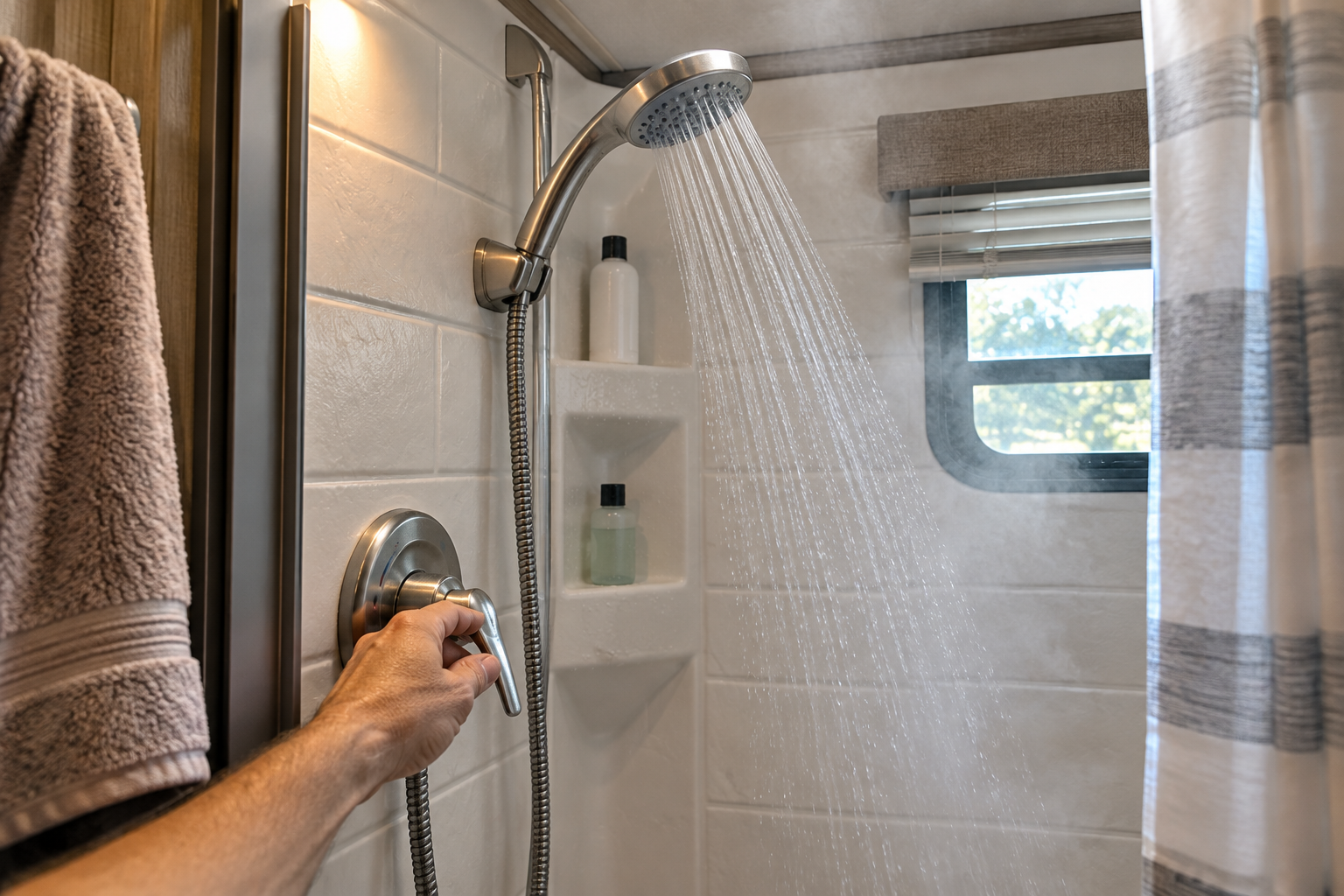
Most tankless RV heaters need about 0.5 GPM minimum to light, and Furrion asks for 35–70 psi of water pressure. Below that, the burner will not light or will cycle on and off.
Many RVers switch to a water-saving shower head, and that can clash with a tankless heater. If the head or the faucet lets through less water than the heater's minimum, the burner never lights or keeps cycling on and off. Fogatti lists 0.5 gallons per minute as the start flow for its Ultra, Suburban asks for 0.5 for its Nautilus, and the Girard manual asks for more. Very low-flow heads and the trickle setting on a shut-off button can drop below that.
Low water pressure causes the same symptom. Furrion lists 35 to 70 psi, so a weak pump or a regulator set too low can keep the burner from lighting. If you run on your water pump, check that it is working well. If you use city water, check that your pressure regulator isn't set too low. Our RV shower head guide covers flow rates, and our RV water pump guide covers pump pressure.
The cold water sandwich is a burst of cold between two hot ones. It happens when you shut the water off and turn it back on a minute later. Hot water left in the pipe comes out first, then cold water that slipped through before the burner relit. Heaters with a small mixing tank, such as the Truma AquaGo and the Fogatti Ultra, are built to reduce it. Otherwise, avoid shutting the water off and on in short bursts.
Will It Fit Your Water Heater Opening?
Most retrofit tankless heaters are designed to go into the opening left by a 6 or 10-gallon tank heater, with a new access door to cover the outside wall. Openings vary by brand and year. Girard calls for a 13-by-13-inch rough opening with square corners, Fogatti sells three door sizes, and Furrion sells doors in several sizes. Measure your opening and the old door before you buy, and match the door to the opening, not just to the heater.
The swap also involves the propane line, the 12-volt feed, the water lines, and the vent through the side wall. The Girard manual says its heater is not designed for do-it-yourself installation and should be installed by a qualified installer or service agency. Treat any RV tankless water heater the same way.
Winterizing and Freeze Protection

Freeze protection on an RV tankless water heater protects the heater, not the rest of your plumbing. The Girard manual says its antifreeze mode fires the burner when the unit drops below about 38°F and stops near 58°F, and it only works with propane on, 12 volts on and the heater switched on. Your pipes, pump and tanks still need their own protection.
- Truma AquaGo: Use the yellow drain lever to empty the heater, and remove and store the inlet filter. Truma sells an optional electric antifreeze kit.
- Girard: blow the lines out with air or run RV antifreeze through, following the manual.
- Furrion and Fogatti: follow your model's owner's manual, since drain points and freeze modes differ.
For the full process, see how to winterize an RV. If you camp in freezing weather, our RV skirting guide covers keeping the underside warm.
Descaling and Upkeep
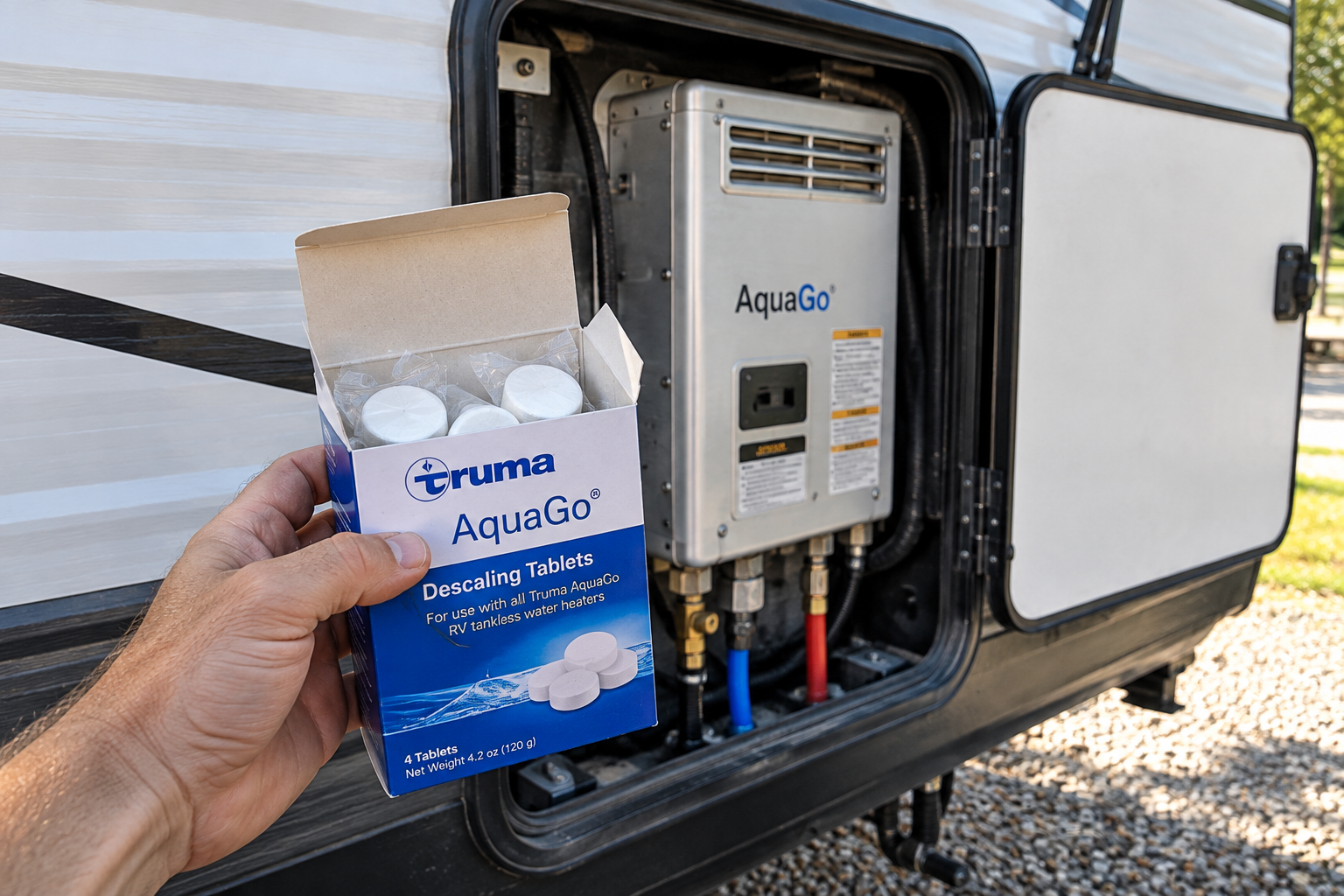
A tankless heater has no anode rod to replace, but minerals in hard water build up inside the heat exchanger and cut performance over time. Fogatti suggests cleaning the heater at least once a year, or every six months if you live in the RV full time. Truma builds a Clean mode into the AquaGo Comfort and Comfort Plus and sells AquaGo descaling tablets.
Clean the inlet filter screen when you descale, and run water through a good RV water filter at the campground spigot. Less sediment going in means less to clean out later.
How to Descale
- Follow the maker's cleaning schedule — most call for once a year, or every six months if you live in the RV full time.
- Use the right descaling solution, such as Truma AquaGo tablets or the Clean mode built into the AquaGo Comfort and Comfort Plus.
- Clean the inlet filter screen at the same time you descale.
- Run water through a good RV water filter to cut down on sediment going in.
Propane and Vent Work
Installing or servicing a tankless water heater involves propane lines and venting. Have a qualified RV technician handle that part — see Safety below.
Common RV Tankless Water Heater Problems
| What you notice | Likely cause | What to try |
|---|---|---|
| No hot water at one faucet | Flow below the heater's minimum | Open the hot tap further, and check the faucet aerator for debris |
| No hot water anywhere | Low water pressure, no 12-volt power, or empty propane tank | Check the pump or regulator, the fuse and the propane level |
| Hot, then a cold burst, then hot | Cold water sandwich | Avoid quick off and on, or choose a model with a mixing tank |
| Hot water gets weak in cold weather | Temperature rise limit | Use a lower-flow shower head that still stays above the minimum |
| Heater shuts off after about 20 minutes | Girard run time limit (code En) | Turn the faucet off and back on |
| Girard code E1 or E2 | Ignition failure or flame loss | Check propane supply and valves, then call a technician |
| Girard code E8 | Air pressure switch, often a blocked vent | Check the outside vent for nests or debris |
| Battery drains while parked | Control board draws power all the time | Switch off the heater's 12-volt power in storage |
The Girard manual notes that its control board draws about 0.2 amps even when idle, so it suggests turning the 12-volt power off in storage or while dry camping (camping without hookups). For deeper repairs, see our RV water heater repair guide.
What About Electric or Portable Tankless Heaters?
Electric tankless heaters are rarely practical in an RV. A 30-amp RV has about 3,600 watts for everything, and even small whole-shower electric units are built for 208 or 240-volt house wiring. A 6-kilowatt unit alone draws 6,000 watts, far more than a 30-amp RV can supply. A 50-amp RV has more power, but its panel almost always has only 120-volt circuits, so a 240-volt tankless heater would need wiring a typical RV does not have.
Portable outdoor propane units, such as the Eccotemp L5 and Camplux models, are different. They hang outside and run from a 20-pound propane cylinder for a camp shower or washing up. Eccotemp sells the L5 as an outdoor heater, and Camplux warns against using its units in enclosed or poorly ventilated spaces. Never set one up inside an RV, its shower, or an awning room.
Safety: What to Leave to a Technician
An RV tankless water heater is a propane appliance with a burner and an exhaust vent. The Girard manual says combustion air must come from outside, exhaust must vent outside, the flue vent must be at least 1 foot from any window, and it must never vent into an enclosed porch, a screen room or an area covered by a canopy. Have a qualified RV technician install it and check the propane connections.
Keep a working carbon monoxide alarm inside the RV and test it often. Our RV carbon monoxide detector guide covers what to buy and where to put it.
Is an RV Tankless Water Heater Worth It?
It is worth it if two or more people shower back to back, you camp for long stretches, or you are tired of waiting for a tank to reheat. It is less worth it if you mostly dry camp with small tanks, since long showers fill the gray tank quickly, or if your water pressure is low and you would need to fix that first.
For most RVers replacing a tank heater, a 60,000 BTU unit with built-in freeze protection, like the Furrion FWH09AFA-AM, is the safest middle choice. If you camp where the incoming water is very cold or you have a family, step up to the Fogatti Ultra.
Quick Answers
Is a tankless water heater worth it in an RV?
Yes, if two or more people shower back-to-back or you camp for long stretches. You get hot water as long as propane, fresh water, and gray tank space last, but flow drops in cold weather.
How long can you shower with an RV tankless water heater?
As long as your propane, fresh water, and gray tank allow. The heater itself does not run out, though some units, like the Girard, stop after about 20 minutes of continuous use by design.
Do RV tankless water heaters work in winter?
Yes, but colder incoming water means less hot water per minute. A 60,000 BTU unit delivers about 1.5 gallons per minute of 105°F water when the incoming water is 40°F, based on an 80% efficiency estimate.
Can I replace my 6-gallon RV water heater with a tankless one?
Usually. Most retrofit units fit 6- or 10-gallon openings with a matching door. Measure the opening first, and have a technician handle the propane, power, and venting.
Why won't my RV tankless water heater turn on?
The most common causes are flow below the heater's minimum, low water pressure, no 12-volt power or an empty propane tank. Open the hot tap further and check your pump or regulator first.
Are there electric RV tankless water heaters?
Most RV tankless units burn propane and use 12 volts for controls. Electric tankless heaters need far more power than a 30-amp RV can supply, so they rarely fit.
Where to Go Next
A tankless heater works best when the rest of your water system is in good shape. Start with an RV shower head that matches the flow, make sure your RV water pump maintains pressure, and filter campground water with an RV water filter. For everything else, browse the RV water and plumbing guides.