
RV stabilizer jacks stop your trailer or fifth wheel from bouncing every time someone walks across the floor or opens a cabinet, but they do a narrower job than most new owners expect. They firm up a rig that is already parked and level. They do not lift it, and they are not a substitute for leveling blocks or a tongue jack. Below are five stabilizer jacks worth buying, what the difference between "stabilizing" and "leveling" actually means, and how much weight these things can really hold.
Quick answer: Stabilizer jacks reduce bounce and sway on an RV that is already parked and level. They are not rated to lift the rig, and they are not leveling jacks. Level first with blocks or a landing gear/tongue jack, chock the wheels, then snug the stabilizers down (not tight). For most travel trailers, a 4-pack of stack or scissor jacks like the Camco Aluminum Stack Jacks covers it. Larger rigs often add a bolt-on rear pair or an electric system.
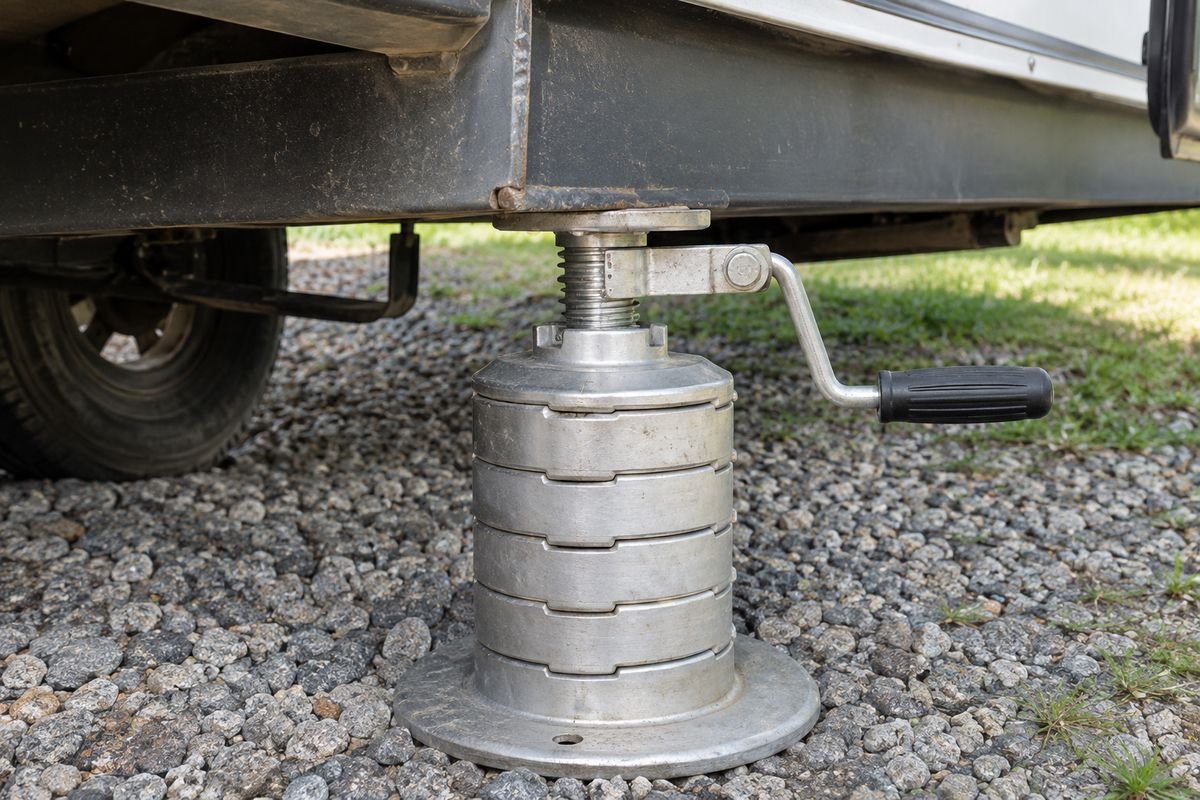
Table of Contents
Stabilizer jacks vs. leveling jacks: Why you need both
These two get mixed up constantly, and the confusion causes real damage. A leveling jack (or a set of leveling blocks under the tires, or a powered landing gear on a fifth wheel) does the heavy work: it gets the RV sitting level front-to-back and side-to-side before you do anything else. A stabilizer jack does a much smaller job after that: it rests lightly against the frame to cut down the bounce and sway that comes from people moving around inside, not from carrying the rig's weight.
RVtravel.com puts it plainly: stabilizer jacks "are not designed to lift your camper." They are meant to be snugged "but not more than snug." Cranking one down past that point can ruin the jack and, because trailer frame rails flex under load, can be enough to make a door stick or a slide-out bind. If you need to lift the RV itself, for a tire change or any underside work, that calls for bottle jacks under the frame or axle, never a stabilizer.
The order matters. Level the rig first, using your leveling blocks or powered landing gear. Chock the wheels so the tires stay planted. Tires actually carry more of the stability than stabilizer jacks do. Only then deploy the stabilizers, snug and no further. If you are still working out whether you need leveling blocks at all, or how high you can safely stack the ones you have, see our guide to RV leveling blocks.
5 RV stabilizer jacks worth a look
Each pick below was in stock on Amazon with an add-to-cart button when we checked. None of these are rated to lift your RV. Use them to firm up a rig that is already level, per the section above.
This is the default stack jack most RVers already own, and it earns that reputation honestly. Four aluminum stands crank down under the frame at each corner, and the 11 to 17 inch range covers most travel trailers and fifth wheels without needing a block underneath.
They are manual, so plan on a few minutes of cranking at each corner rather than one switch. On soft ground, set each foot on its own small block or paver first, since a stack jack can tip on loose gravel or grass without one.
Good
- Lightest option here to carry and store
- 11 to 17 in range covers most trailers with no extra blocks
- Widely stocked, easy to find replacement parts and pads
Bad
- Manual crank only, slower than an electric system
- Can wobble on soft or uneven ground without a block under each foot
One switch runs both legs on this front or rear-mount system, and it auto-adjusts to uneven terrain rather than making you eyeball it. Worth the jump in price if backs or knees make hand-cranking four corners a chore, or if you set up and break camp often enough that the time adds up.
It is a motor, which means it can fail like one. The RVtravel.com piece above specifically flags motorized stabilizers stalling or getting stuck under added load: one reader there reported roughly $800 in repairs after raising a trailer's nose with the rear jacks still down. Keep the same order-of-operations rule: level the tongue or landing gear first, then deploy this.
Good
- One switch deploys both legs, no cranking
- Auto terrain adjustment compensates for uneven ground
- Heavy-gauge steel holds up to repeated use
Bad
- Costs several times what a manual set runs
- Needs a 12V hookup and real mounting hardware
- A motor failure mid-trip leaves no easy manual backup
A scissor jack cranks up and down faster than a screw-style stand, and this one folds flat against the frame when it's stowed. It's sold individually rather than in a set, which is actually useful if your trailer's mounting points call for an odd number or you only need to replace one.
The trade-off is capacity: at 1,000 lb per jack, it's the lowest rating on this list. Check how many jack mounting points your frame actually has and don't lean on fewer jacks than the manufacturer specifies for your trailer's weight.
Good
- Scissor action is fast to crank up and down
- Compact folded profile tucks against the frame
- Sold singly, so you buy the exact count you need
Bad
- Lowest per-jack capacity on this list
- A 4-corner setup means 4 separate orders and hardware sets
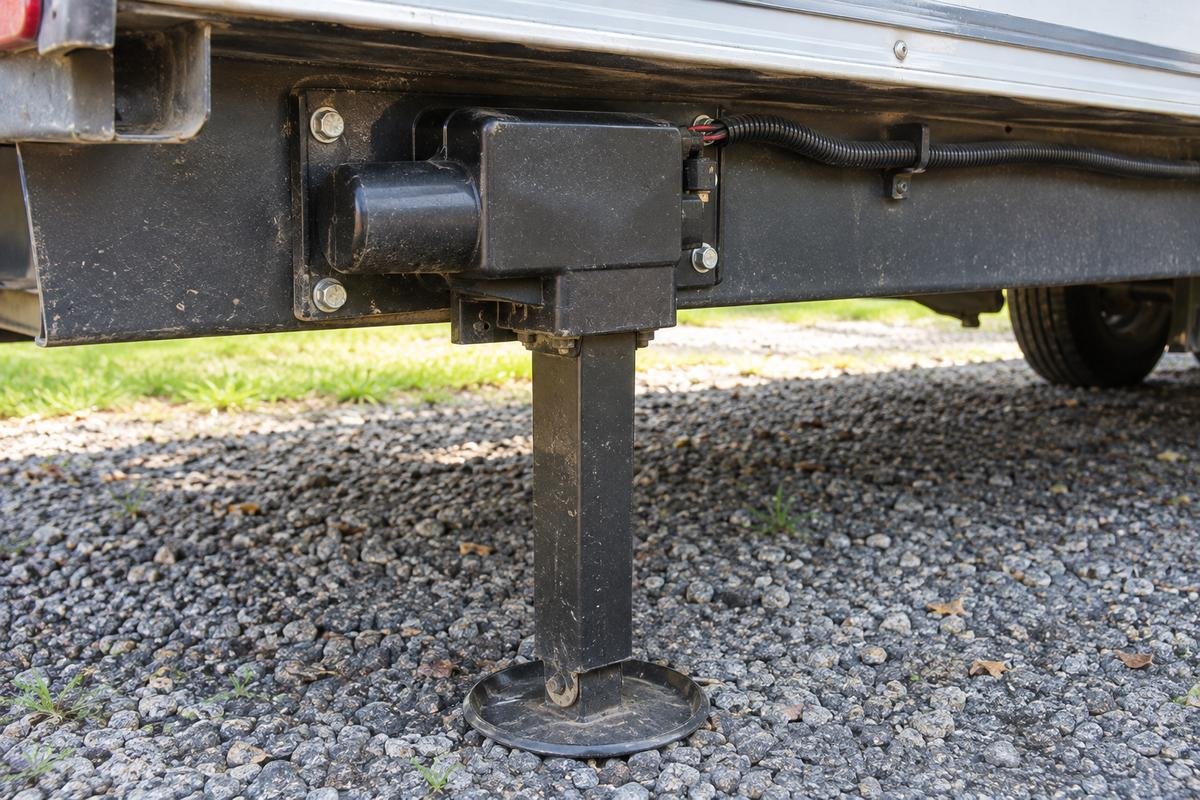
These bolt permanently to the frame and swing down from a stowed position, so there's no separate jack to carry, store, or misplace between trips. They're built for the rear of the trailer, paired with the tongue jack or landing gear doing the leveling work up front.
The trade-off is the permanent install: this isn't a grab-and-set-up accessory like the stack or scissor jacks above. It's also sold as a 2-pack for the rear only, so a full 4-corner setup needs a second product for the front.
Good
- No separate jack to store or lose between trips
- Pairs well with a front tongue jack for a 3-point setup
- Alloy steel resists rust better than painted steel
Bad
- Permanent bolt-on install, not a quick swap
- Rear-only 2-pack, needs a second product up front
This matches the Camco pick's weight rating and extension range almost exactly, for noticeably less. Same stack-and-crank style, same aluminum build, same 11 to 17 inch range: the main thing the extra money buys with the Camco name is a much longer track record of reviews.
Budget stack jacks tend to wear at the same two points first: the crank handle and the screw threads. Expect to replace those sooner than you would on a heavier-duty set if you're using this as your daily driver rather than occasional camping.
Good
- Matches the Camco pick's rating and range for less
- Aluminum build keeps the full 4-pack light
- Sold and shipped directly through Amazon
Bad
- Shorter review history than the Camco pick
- Crank handle and threads are the first parts to wear on full-time use
Quick comparison
Swipe to see more →
| Pick | Style | Weight Rating | Extension | Best For |
|---|---|---|---|---|
| Camco Aluminum Stack Jacks | Stack/screw | 6,000 lb | 11 to 17 in | Most trailers, lightest to store |
| Lippert PSX1 | Electric power | Not lift-rated | 30 in | Hands-free setup, auto terrain adjust |
| Bal 23007 | Scissor | 1,000 lb | Up to 16 in | Buying the exact jack count you need |
| Husky Towing 88150 | Drop-leg, bolt-on | Frame-mounted | N/A | Permanent rear setup with a front jack |
| VEVOR 4-Pack | Stack/screw | 6,000 lb | 11 to 17 in | Budget match to the Camco spec |
Sizing and compatibility: What to check before you buy
The extension range on the spec sheet only matters if it actually reaches your frame. Level the RV first, then measure the real gap between the frame rail and the ground at each corner before you order anything. A jack rated for 11 to 17 inches that just barely reaches a 17 inch gap leaves no margin for a sloped site or a future tire change.
Stowed height matters most for drop-leg and electric systems, since they bolt to the frame and stay there. Check the clearance between the frame and the ground when the jack is fully retracted. A low-riding trailer can still drag a permanently mounted jack on a speed bump or a steep driveway transition even when it's stowed correctly.
- Stack and scissor jacks mount nowhere. They crank up from the ground rather than bolting to anything, so they fit almost any frame. This is why they're the default pick for most trailers.
- Drop-leg and electric systems bolt to the frame rail. Not every trailer has a flat, accessible spot in the right location. Check your owner's manual or measure your own frame before ordering a bolt-on system, since returning a heavy steel bracket is more of a hassle than returning a stack jack.
- Soft ground changes the math for any style. A jack with a small footprint needs a block or paver underneath on grass, sand, or gravel, regardless of how it mounts.
How much weight can RV stabilizer jacks hold?
The number on the box isn't a lifting rating
Manual stack and scissor jacks are commonly rated anywhere from 1,000 to 6,000 lb, but that figure describes how much downward load the jack's body can resist without bending, not how much of your RV's weight it's meant to carry. Used correctly, a stabilizer carries almost none of the rig's weight. The tires and axles still do that job.
That's why the picks above range so widely on paper (1,000 lb for the Bal scissor jack vs. 6,000 lb for the Camco and VEVOR stack jacks) without one being meaningfully safer than another in normal use. The rating matters more if a jack gets over-tightened or the frame settles onto it unevenly, since a higher-rated jack has more margin before it bends or jams. It still isn't a reason to crank a jack down past snug.
How to use RV stabilizer jacks correctly
- Level the RV first. Use leveling blocks under the tires, or your tongue jack/powered landing gear, before touching the stabilizers. See our leveling blocks guide if you're not sure how high you can safely stack them.
- Chock the wheels. See our guide to trailer wheel chocks for which type fits your setup. The tires should stay planted on the ground. They provide more real stability than the jacks do.
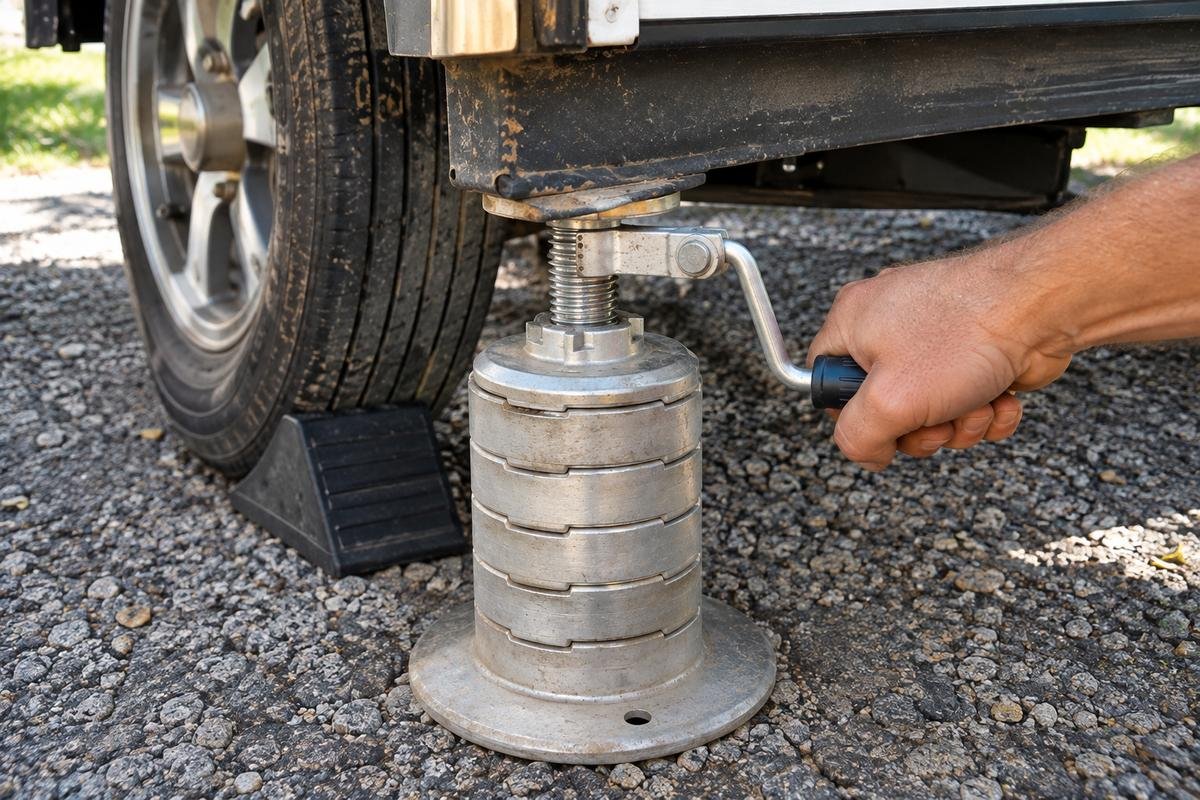
- Deploy the stabilizers last, snug only. Crank or power each one down until it just touches and takes up the slack. Stop there.
- Check all four corners are even. An unevenly snugged set can still let the rig rock on the one corner that's loose.
- Retract fully before towing. A stabilizer left even partially down will drag, bend, or tear loose the moment the RV moves.
Common stabilizer jack mistakes
Most stabilizer jack failures trace back to one of these, not to a bad product:
- Cranking past snug. This is the single most common cause of a ruined jack, and it can flex the frame enough to jam a slide-out or stick a door.
- Using them to lift the RV. For a tire change or underside work, use bottle jacks under the frame or axle, never a stabilizer, and never crawl under a rig supported by a single jack.
- Skipping the wheel chocks. Without chocks, the stabilizers end up taking on load they were never built for.
- Setting the rear jacks before the front is level. Extra load on the stabilizers from an unlevel tongue or landing gear is a common way to jam an electric jack's motor.
- Forgetting to retract before driving off. Walk all four corners before you pull out, every time.
Troubleshooting common stabilizer jack problems
- Jack won't crank or feels stuck. Usually dirt, rust, or dried grease in the screw threads, especially on a stack jack that's sat uncovered for a season. Clean and re-grease the threads before assuming the jack is broken.
- Electric jack hums or trips a breaker but doesn't move. Usually an underpowered 12V connection rather than a failed motor. Check the wiring gauge and the connection at the battery or converter before replacing the unit.
- Jack feels wobbly even when snug. Means it isn't touching the frame evenly, often because the ground under that corner settled or the RV wasn't fully level before the stabilizers went down. Re-level and re-snug rather than cranking the wobbly jack down harder.
- Jack won't retract fully. Usually means it's still under load, not a mechanical failure. Re-level the corner to take the weight off the jack first, then retract.
- Jack is dragging or scraping while driving. It wasn't fully retracted. Walk all four corners and confirm full retraction before every departure.
Which type of stabilizer jack is right for you?
- Stack or screw, like the Camco or VEVOR picks. The default choice for most travel trailers and fifth wheels. Cheap to replace one at a time, works on almost any frame, and the parts are easy to find.
- Scissor, like the Bal pick. Cranks up and down faster than a stack jack and folds flat when stowed. Sold individually, so it's a good fit if your trailer needs an odd number of jacks or you only need to replace one.
- Drop-leg or bolt-on, like the Husky Towing pick. Best if you never want to carry, store, or misplace a separate jack between trips. The trade-off is a permanent install and checking that your frame has the right mounting points first.
- Electric, like the Lippert PSX1. Best if hand-cranking four corners is hard on your back or knees, or you set up and break camp often enough that the time adds up. Costs more and needs a 12V connection.
If you're not sure, start with the stack or screw style. It's inexpensive, works on nearly any frame, and the parts are easy to replace. Move to a drop-leg or electric system only once you've identified a specific reason the manual stack style doesn't work for your setup.
Electric vs. manual stabilizer jacks
Manual stack and scissor jacks, like the Camco, VEVOR and Bal picks above, cost less, have nothing to fail electrically, and are simple to replace one at a time. Electric systems like the Lippert PSX1 trade that simplicity for speed and less physical effort: genuinely worth it for anyone who sets up or breaks camp often, or who has a hard time cranking four corners by hand.
There's a third approach worth knowing about even though it isn't one of the picks above: frame or hitch-mounted anti-sway bracing, such as MORryde's X-Brace line. That's a different product category entirely (a rigid brace rather than a jack), sold mainly through specialty RV parts retailers rather than Amazon, and it solves a related but distinct problem (reducing sway at the hitch, not bounce from walking around inside).
Are RV stabilizer jacks worth it?
For anything beyond an overnight stop, yes. A trailer with no stabilizers deployed will rock noticeably every time someone walks to the bathroom or climbs into bed, and that gets old fast on an extended stay. They're inexpensive relative to almost anything else on an RV, they install in minutes, and the only real way to do it wrong is to crank them past snug or skip the leveling step first.
What is the difference between stabilizer jacks and leveling jacks for an RV?
Leveling jacks (or leveling blocks and a tongue jack or landing gear) get the RV sitting level front-to-back and side-to-side. Stabilizer jacks do a smaller job after that: they rest lightly against the frame to cut down bounce and sway from people moving inside, not to carry the rig's weight.
How much weight can RV stabilizer jacks hold?
Manual stabilizer jacks are commonly rated from 1,000 to 6,000 lb, but that figure describes the jack body's resistance to bending, not a lifting capacity. Used correctly, a stabilizer carries almost none of the RV's actual weight. The tires and axles still do that job.
How do I use RV stabilizer jacks correctly?
Level the RV first with leveling blocks or a tongue jack/landing gear, chock the wheels, then crank or power each stabilizer down until it just touches and takes up the slack. Stop there. Cranking past snug can ruin the jack and flex the frame.
How do I stop my RV from shaking when I walk?
Make sure the RV is fully level first, then deploy stabilizer jacks snug at all four corners. An unevenly snugged set, or one corner left loose, will still let the rig rock even with the others set correctly.
Are electric stabilizer jacks worth it?
If backs or knees make hand-cranking four corners a chore, or you set up and break camp often, yes. They cost several times more than a manual set and can stall under added load if the rig isn't level first, so the same order-of-operations rule still applies.
Can stabilizer jacks replace leveling blocks?
No. Stabilizer jacks are not rated to lift the RV, so they can't level a tilted rig the way leveling blocks under the tires can. Level first, then stabilize.